Blog

In which I am genuinely confused by the gay marriage debate

Yesterday British MPs voted in favour of allowing gay marriage in the UK. Yay! At least a moderate yay! I’m not gay and so aren’t really planning to do any gay marrying, so it’s not a massive YAY! like it would be for the really properly important stuff that actually affects me. But some people are gay and some of those people want to get married so it’s definitely a yay! for them.

What I am a bit confused about is why anyone who isn’t wanting to have a gay marriage themselves would care enough to actively oppose the idea? This is the absolute definition of an issue that really doesn’t affect anyone else. Objecting morally to gay marriage isn’t the same as objecting morally to stealing. Someone choosing to steal adversely affects the person they steal from. Two people choosing to get married doesn’t adversely affect anyone, unless you’re in love with one of the getting-married people, but then your problem is really that they love someone else – the marrying someone else is simply the cherry on top of the icing on top of your cake of heartachey-pain.

I was absolutely certain that gay marriage didn’t affect me, apart from in a broad “it would probably be good to live in as fair and equal society as possible” sort of a way. But then it was pointed out to me that it does affect me. My husband drew my attention to the issue, and a man on Radio 4 drew his attention to the issue. You can rely on Radio 4 for drawing your attention to things, for example, in this case, it drew my attention to the fact that EngineerBoy has become prematurely middle aged and started listening to Radio 4.

Anyway, I digress. In this instance Radio 4 drew our attention to the fact that some of the objections to gay marriage are predicated around the notion that a marriage between a man and a woman exists, in substantial part, for the purposes of making and raising babies. There’s two issues there – we’ll deal with the one that isn’t just all about Me first.

It’s not just straight people who want to raise children. I know. Who knew? Some gay people like the idea of doing their child-raising within a marriage. Clearly, there are some additional challenges for a same-sex couple in the area of actual baby-making. However, we live in a society where there are children who can’t be cared for by their biological parents and need loving adoptive carers. If you feel that parenting is something best done by married people (for the record I don’t personally feel that particularly, but some other people do), then gay marriage is a big positive for lots of potential adoptive children. Yay again!

And now onto the bit that is mainly about Me – the idea that marriage is substantially about raising children causes me some concern. I’m married. I appear, by the “raising children” standard, to be doing it wrong. I’ve never really wanted kids (a characteristic I mused on at much greater length here). Neither has EngineerBoy. This is just one of the very good reasons that it’s fortunate we married each other, rather than lumbering two other poor unfortunates who might have been of more baby-friendly mindsets. The implication seems to be that I’m not doing marriage properly. It would appear that quite inadvertantly, and despite having married someone of the opposite sex, I have made a union that some people would equate with a same-sex marriage. So Yay! indeed for MPs voting in favour of gay marriage – it turns out it does affect me after all.

Or to put it more concisely – people loving each other is nice. People wanting to celebrate that love with their friends and family is nice. People wanting their community to recognise their commitment to each other is nice. People wanting to love and raise children is nice. None of those things are compulsory. None of those things follow automatically from the one before. Everyone having the option is good, and giving everyone the option doesn’t really make the tiniest bit of difference to anybody else.

Farewell then. See you all back here next week?

UPDATE: I’ve just had a query over on fb about my use of the term gay marriage rather than equal marriage, suggesting that equal marriage is a preferable term. I’d broadly agree with that. I’ve used “gay marriage” as a term in this post because that’s the common term used in a lot of media and because that tends to be the term that opponents of equal marriage use, and it’s really the thought process leading to opposition that I’m musing on in my own mind today rather than the actual issue of equal marriage itself. Hope no offence is caused by my choice of terminology.
In which I go to the pictures, try to tidy my office and worry that I might not be a Proper Girl.

I’m writing this perched amongst the debris from my most recent attempt to tidy my office. My office is an important room for me. It started off, nearly ten years ago when myself and EngineerBoy persuaded a bank to buy us a house (that is how that works, isn’t it?), as our shared home office. Steadily, but decisively, the Boy has been phased out of this little bit of supposedly shared space, and the office claimed as my tiny box-sized writing room. At least it’s supposed to be a writing room. In real life, writing doesn’t earn me any actual money, and I’ve just discovered that we need actual money to give the bank so we can carry on living in the aforementioned house. Frankly, that’s a much poorer deal that I was imagining.

But the office, yes, it’s not just my writing room. It’s also the office from which I run my freelance training business and home to my folders of random business related receipts, and course notes and lesson plans on everything from Welfare Benefits law to writing a villanelle.

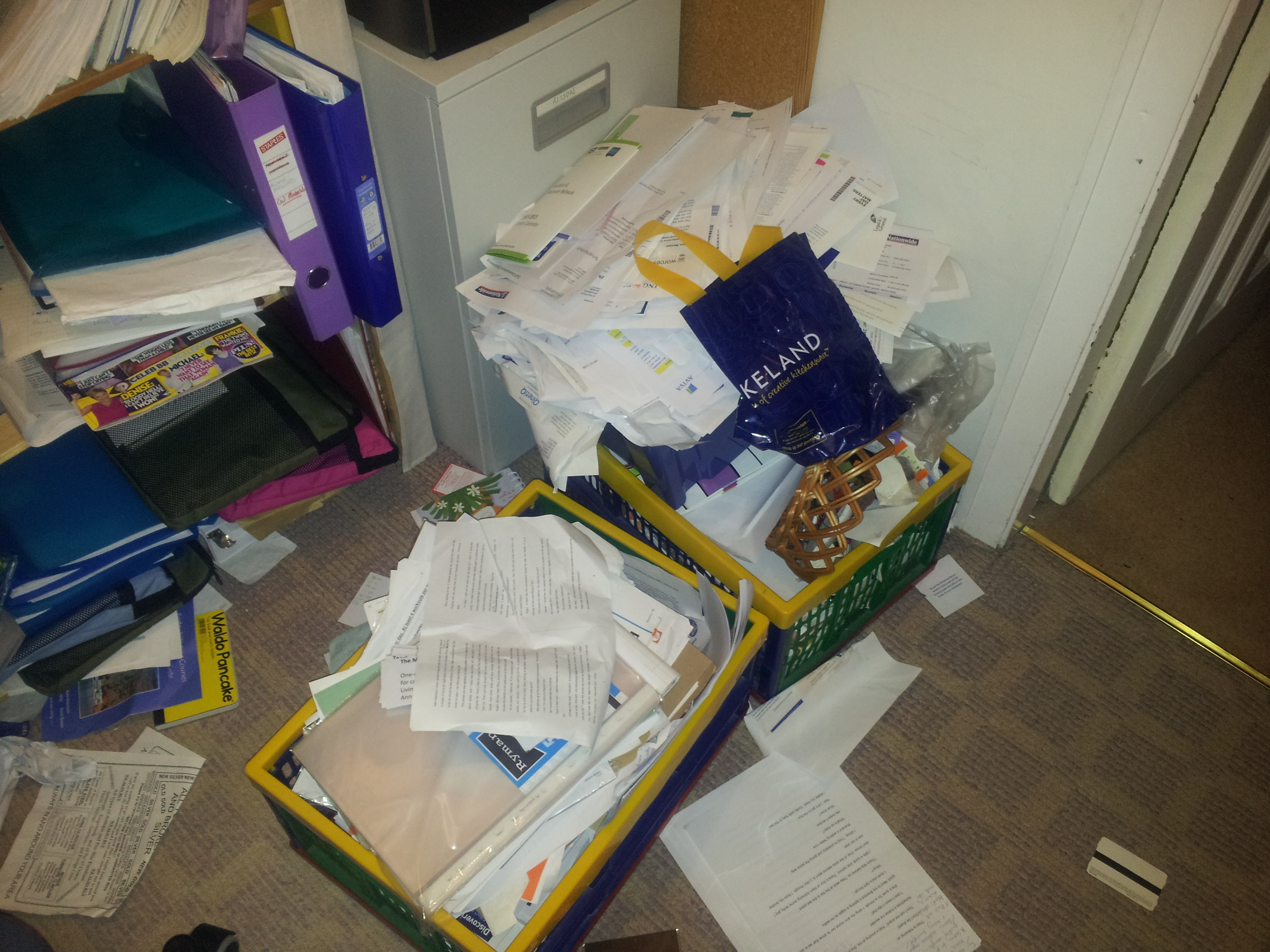
And it’s a mess. A proper, possibly infested, men-behaving-badly type of mess. Yesterday, in a fit of good intention, I cleared all the random paperwork off the desk and into a box, which is now sitting on the floor waiting for me to sort through the paper mountain. Somewhat dishearteningly, it’s sitting next to two full crates from the previous times I’ve done the same thing. Oooops?

messy messy office


And yes, that is a lakeland carrier on top of one of the piles. And, weirdly, it does contain cookie cutters. And no, I have no idea why it’s in my office.

All of which is a bit of a worry. I’m a girl, after all. Aren’t girls supposed to be clean and tidy beings? Sugar and spice and all that? Even this article defending the joys of raising sons concedes that they “do tend to be noisier, messier and more aggressive than girls.”

No matter. There have been plenty of chances to assert my femininity of late. For example, in the last couple of weeks I’ve been to see two of a the big film releases of December/January: The Hobbit and Les Miserables. Now these look like the sorts of films where you could expect a fairly predictable gender-split in terms of enjoyment. One of them is a searing epic of love, loss and redemption told through the medium of a fully sung-through musical, and the other one is about dwarves. Both are stupidly longer than they need to be, but apart from that, I did, as expected very much enjoy one and feel entirely “Meh” about the other.

However, the one I very much enjoyed was The Hobbit. It had wizards, and awks, and a dragon, and a range of recognisable actors with comedy stick-on hair arrangements. Really, what’s not to like?

Les Mis, on the other hand, left me underwhelmed, although I can’t quite put my finger on why. I didn’t mind the live-singing, even though that meant that it lacked the polish of most film musicals. I didn’t even mind the fact that you could see the pressure of trying to act and sing AT THE SAME TIME etched on Russell Crowe’s face. I very much minded the amount of noble dying, and I definitely minded the amount of gazing into the middle distance looking a bit wan. And at no point did I feel on the verge of weeping the copious tears that various (mainly female) friends had led me to expect.

Add to that the fact that I taught a creative writing class last night where my mere mention of Terry Pratchett (my absolute definite favourite writer) led to great excitement from the male students and absolute indifference from the women, and I’m starting to worry that I might not be a Proper Girl.

Happily that’s very obviously a stupid thought. I’m clearly a girl. I definitely have boobies, and I own more than two pairs of shoes. I like chick lit and baking and bubble baths and accessorizing, and also football and sci-fi and not tidying up. I’m girlishly pathetic about pretty much all forms of DIY, and blokeishly underwhelemed by pretty much all forms of romance. So probably it’s not me that’s weird. Probably it’s our tendency to think of some traits as masculine and some as feminine, rather than just thinking of people as individuals, that is weird. Yeah – that’s it. I’m not messy – I’m asserting my individual right to choose not to conform to gender stereotypes. Go me!

So how about you? Are you a rugby-playing make-up lover? Or a testosterone fuelled natural home maker? Talk to me people…

In which I think about Michael Gove and it makes me go “Grrrrrrr.”

Last week I claimed I was going to blog about MPs voting on a 30% pay rise for themselves in the same week as approving a 1% cap on welfare benefits rises. It turns out that was lies, not least because it would be a very short blog. It’s pretty much obscene. That’s all I really want to say.

So now I can move onto other issues, and the thing that has caught my flutter-minded attention today is the intriguing phenomena that is Michael Gove. Mr Gove, the Gove-ster if you will, is Education Secretary. Just to be clear, that means that he’s in charge of education policy for England, not that he does the typing.

Since taking office Gove has had three main headline-grabbing policies. First he decided that he would send a bible to every school. Then he decided that GCSEs were too easy and he wants the young people of today to do proper old-fashioned manly academic exams instead. Today, he’s decided that A-levels, in their current form, are too easy and he wants the young people of today to do proper old-fashioned manly academic exams instead. And yes, I do see that technically, that’s only two policies, and the first one of those is just silly anyway.

The bible for every school thing is daft, not least because it’s pretty much the most widely available book on the face of the planet. The whole thing’s available for free online in multiple different editions and languages. Amazon will download you the full King James, Gove’s preferred version, to kindle free and gratis. If anything is holding back the educational progress of British schools, I think we can say with some confidence, that it’s not the inability to access bible texts.

So let’s have a look at his 2nd policy – the idea that young people today aren’t learning enough proper hard academic stuff and that exams should be harder. In both the replacements for GCSEs and the current A-levels one of the key ideas is that assessment will be by a single end-of-course examination, set and assessed by an external body.

Now that’s something I should probably be in favour of. I was one of those annoying kids who was good at exams. I passed the coursework part of my History A-level by writing the full 5000 word course work essay over a single night, starting at 6pm the night before it had to be handed in. Essentially I reduced the whole research-draft-reflect-revise coursework process into a 12 hour high pressure exam.

But I’m not blown away by Gove’s ideas, and I’m not blown away because I have no faith at all that he understands what he’s actually doing. Designing assessment in education is hard. Good assessments are ones which have reliability, validity and fairness.

Reliability, is sometimes called replicability. Essentially it means that if the same student, with the same level of knowledge/skill, took the same assessment at a different time and place they would get broadly the same result. Similarly, results between similar groups of students should be consistent.

Validity means that you are actually testing the thing you are setting out to test. This is incredibly difficult. If you are trying to assess knowledge of a particular subject, do you do it by ongoing course work or by single exam? Ongoing coursework might assess subject knowledge, but it also assesses research skills, time management, organisation, and possibly, ability to copy from the internet or get your mum/friend/teacher to write it for you. Single exam assesses subject knowledge, but also ability to cope with pressure, ability to write quickly, ability to cram or revise, and possibly, creativity and imagination in your approach to cheating. Coming up with a form of assessment that solely assesses the thing you’re claiming to assess is all but impossible, and I don’t think Michael Gove understand that.

Fairness means that all your students have a fair crack at getting a good result – it relates closely to validity. It covers things like not assessing students’ descriptive writing by asking them to write a paragraph describing the taste of bacon. Jewish students, for example, are likely to find that significantly harder than a child who’s eaten a full english every day for the last 16 years.

So, yes, review assessment and education processes. It’s important that we make them as good as we can, but understand that doing that is really difficult. Simply deciding to make it “tougher,” or “more academic,” or – and this is what a lot of education reforms ultimately amount to – “more like it was in my day,” is lazy policy making. And it’s policy making with no basis in evidence, and no basis in an understanding of how learning and assessment work.

Several eons ago I had a little rant on this very blog about the rise of the career politician, and Michael Gove is a prime example of why this matters. Gove is a product of the political bubble. Prior to entering Parliament, he was a political journalist and the chair of a conservative thinktank. If only there was some sort of training or job one could do that would allow a person to enter politics with some knowledge of how education works, or doesn’t work. But no… I can’t think of any such career. Oh wait. Hold on one tiny little second. There’s actually being a teacher. There’s an idea. How about having an Education Secretary who knows something about education, beyond a general sense that things were better in the old days, and that every child’s schoolday would be best commenced with a gown and mortar-boarded master reading verses from the King James Bible before requiring the boys (and weirdly in the mental picture I’m creating there are only boys) to recite their 12 times tables out loud until their tonsils start to bleed?

I think that’s all. In summary – Michael Gove: grrrrr. Comments please!

In which I share some thoughts about localism

The current government are very keen to talk about localism. It’s second only to the, much talked about but rarely explained, Big Society, on their list of favoured nebulous concepts that sound like they might possible be a good idea, but only in a way sufficiently vague not to offend anybody.

Localism is more than just an idea though. It’s a whole Act of Parliament. The Localism Act, passed in November 2011, covers areas such as planning, local council structures and housing provision. The claim is that the Act, and other pieces of coalition policy, make decision making more localised and, therefore, more directly accountable to local voters. It’s dubious whether the Act actually does that at all. For example, the Act allows central government to cap levels of council tax rise, and define who should be considered high priority in housing allocation.

The other poster-policy for localism has been the introduction of elected police commissioners. Commissioners were elected in November 2012 with stunningly low turnout and high levels of spoilt papers. The idea is that an elected police commissioner is more accountable than a committee-based police authority, and, therefore, power is handed-back to the wider electorate.

Let’s unpick that a bit. A major premise here is that elected individuals are intrinsically more accountable. In one sense that’s clearly true. After a specified period of time the people who chose them get to consider their successes and failures and decide whether to let them carry on. However, it’s only true in a very limited sense. Officials elected for a fixed term are incredibly difficult to get rid of before the end of that term. If an elected police commissioner is just a bit irritatingly incompetent there’s no neat way of sacking them until election time comes around. (Worryingly, the same is true of Prime Ministers.) That means that an elected police commissioner in the first couple of years isn’t really accountable at all, knowing that all but the most major cock-ups of the first half of the term will be forgotten by election time. Similarly, a police commissioner with no intention of standing for re-election isn’t accountable to anyone at all, knowing that they will never actually have to explain their decisions or defend their record.

There’s another problem with the localism agenda and it’s highlighted by playing a very simple game when you watch the news. Every time you hear a national politician talking about “increasing local accountability,” simply replace the phrase with the words “decreasing our accountability,” because that’s what it means. Frustrated by the slow response of the police? That would be a local issue. Cold, wet, and hungry because of the lack of affordable housing? That would be a local issue.  But they’re not local issues, because central government retains its control of the purse strings. They want local police forces and local councils to appear accountable for local decisions, but they also want to maintain a capped level of council tax and reduce national police funding. That means that local councils and police commissioners are expected to be accountable for reduced outputs, but aren’t allowed to control the financial inputs.

More recently, the Local Government Secretary, Eric Pickles, has gone further, demanding that local councils re-instate weekly bin collections, and threatening cuts in funding for those who don’t comply. You can understand Pickles’ concern over the bin-emptying turmoil sweeping the country. I don’t see anyway that a rational individual could look across the national political landscape and conclude that anything other than how often people’s wheely bins get emptied was the most pressing issue facing the nation.

What we have here is central government setting local decision makers up to take the blame for the way that national policies play out in local communities. Local councils and police commissioners aren’t able to set their own budgets and, increasingly, see their spending priorities dictated from Westminster too. They then take the flak for reductions in local services, because, the coalition tell us, these are local issues. All the while, the coalition talk about localism, directing voter’s attention, and anger, towards their local politicians, rather than national government, which is naughty of them really. Bad politicians. Bad.

So that’s my little rantette for this week. Come back next week, when there’s a reasonable chance I’ll be talking about 1% rises in welfare benefits and 30% rises in MPs’ pay, unless something more interesting distracts me in the meantime of course. Toodle-pip.

In which I look forward to yet another new year

So it’s January again. It seems, dear reader, to have come round a bit quick, but the calendar never lies. Actually that’s rubbish. My calendar says it’s 2010, so can’t really be trusted for anything very much at all anymore. But, depsite my calendar’s confident assertion that it is eternally December 2010, it is, quite clearly, January all over again, and time to do the whole resolution thing once more with feeling.

To get me in the mood for this I had a little lookie back here to see what I’d resolved last year. I won’t lie. It was a tad disheartening, because basically I’m going to be resolving all the same stuff again. I still need to lose weight, about half a stone less than I needed to lose at the start of last year, but the bigger picture is still rather unhealthily hefty. I still need to focus more on writing, and I still need to get over my utter phobia of being in control of a moving automobile.

Now that realisation might give the impression that 2012 was not a successful year. That would not be true at all. 2012 was great. I went to the Paralympics. I gained a very gorgeous niece.  I went to Venice (and Venice is, in my humble opinion, amongst the very best of the good places on the planet). I won a short story competition which earned me a year’s guardianship of a little cup. I saw a panda in Edinburgh Zoo on my 10th wedding anniversary. I joined a tiny little writer’s critique group all of whom say fabulously useful things, and frequently offer me cake. I spent time doing things with people I like.

It wasn’t a year into which no rain fell. My incredible, irrepressible grandmother died at the age of 97 in June. I was poorly for a slightly disappointing proportion of it (rather inconveniently I seem to have developed IBS). And, as we’ve already noted, I didn’t really achieve my stated goals for the year at all.

So maybe that should tell me that resolutions really are a waste of time. Maybe I should stop aiming for things I’m probably not going to achieve, and concentrate on enjoying whatever comes my way. Well, partly. The “enjoying whatever comes my way” sounds good, but I still think the resolutions are worthwhile too. Because, somehow, I absolutely believe that this year will be different. This year I will do better. I think it’s good to believe that – it makes us keep trying. I don’t really do bumper-sticker wisdom. The cute sayings and affirmations that people post on their facebook statuses leave me befuddled, but here’s one I do believe. I believe that it is, pretty much always, better to try and fail, than not to try.

So in a spirit of trying, and embracing the risk of failing, here are my resolutions for 2013:

1. Lose weight – 3 stone 10lb to be precise. And keep it off.

2. Finish writing a second novel, start a third, and submit a competition short story at least once per month.

3. Get over the driving phobia.

4. Get back to blogging every(ish) week. On that note – the all new blog day for 2013 is Wednesday. Mark it on your (possibly decades out of date) calendars – Wednesday. Wednesday. Wednesday.

You never know – this might be the year I stick to all my resolutions. And if not, I’m sure the failing will bring it’s own joys along with it. See y’all back here for a review in 2014?

In which I acknowledge being a bad blogger and offer a small festive story in way of apology

I have been a bad blogger of late. I have failed to offer you Monday thoughts on the Chancellor’s Autumn Statement, David Cameron’s reaction to the Leveson Report, the freakishly rapidly decreasing size of Curly-Wurlys, or the upcoming festive season. And I have thoughts on all these things. Oh yes, indeedy, I have thoughts.

Alas, of late time has been short, and life has been busy so these many and fascinating thoughts have remained unblogged. Please accept my humblest apologies and this short festive storyette in recompense. Normal thought-sharing service shall be resumed in January. Promise.


The Shepherd

“So Bob,” Miss Pennydew shuffles slightly in her seat. “I think you know why we’ve asked you here today.”

“Aye.”

“It’s…” She coughs. “It’s about last Monday. We’ve.. em… we’ve talked to young Sam, but I just wanted to give you the opportunity to take us through your version of events, just as you see it, from your point of view.”

“Aye.”

Miss Pennydew pauses. “Just in your own words…”

“Aye.”

“Whenever you’re ready.” She waits for Bob to fill the silence. The silence extends. “Ok. Well, what if I run through Sam’s account and you can just jump in whenever you think?”

“Reet.”

“So Sam told us, with regard to the incident in question, that he initially noticed an unusually bright star.”

“Aye.”

“And then…?” She tails off. “Ok. And then Sam says…” She consults her notes. “He says that you were surrounded by a heavenly throng.”

Bob nods, apparently feeling that he’s said quite enough already.

“After which one of the…” She makes quotation mark fingers. “…’throng’ addressed you telling you not to fear.”

“Aye.”

“Sam said that this was because a…” She does the fingers again. “…’mighty dread’ had seized your troubled minds.”

Bob pulls a face, suggestive, he hopes, of the notion that Sam might do better with a bit less book-learning and a bit more watching of the flock by night.

“After which, and you’ll understand our concern here, it appears that both yourself and Sam, left the flock and went into town with the intention of visiting a newborn baby, apparently located in a stable.”

“Aye.”

“Just to be clear…” She smiles, the sort of smile that hints at men in white coats and the idea that Bob might like to take a little bit of time off quite soon. “..You didn’t know the family with the baby? They weren’t relatives or close friends?”

“No.”

“You, and Sam, simply decided to leave the sheep, and visit a baby because you were told to by a ‘heavenly throng’.”

“Aye.”

“And, still just so I’m clear – no one’s in trouble here – you hadn’t been erm… drinking at all prior to leaving the flock.”

Bob shakes his head.

“Ok. Not that I’m accusing anyone. I’m sure a little drink every now and then to keep the cold out won’t do any harm, especially at Christmas.”

She pauses and re-runs the sentence in her head. Bob crinkles his brow.

“Anyhow, you do understand our concern, I’m sure. Given that your current role is very much sheep-focussed, any time spent outside of immediate shepherding arena, should really be booked in advance using the green form, which then has to be approved by myself or Mr Hargreaves.”

“Aye.”

“Good. Good.” She does the smile again. “Well, so long as that’s clear.”


In which I am slightly confused by the BBC’s employment practices

So the BBC is having something of a kerfuffle. I think kerfuffle is the right term. Some media outlets would have it that the BBC is in irredeemable crisis, but those are media outlets with short memories (fallout from the Hutton Enquiry anyone?) and lazy typing brains, so their opinions are best stepped over like the slightly muddy puddle that they are. Anyone would think there was some sort of big report on print media ethics coming out soon, that they maybe wanted to distract attention from.

I should probably make plain right now that I’m a big ol’ fan of the BBC. I think public interest broadcasting is massively important. I’m with Mitch Benn on this one (even given the slightly unfortunate reference to Newsnight in line one).

I think that Doctor Who, Only Connect, most of Radio 4 (but not The Archers, never, ever, ever The Archers) and everything ever made involving Brian Cox, Alice Roberts or David Attenborough justify the licence fee in full, making things like decent news coverage an (albeit essential to making democracy work) add-on benefit.

It is unfortunate for the BBC that it finds itself unable to defend itself without being accused of bias, and that the rest of the media sees it as a competitor so is very happy to stoke the flames of any perceived problem or mismanagement. It also seems clear that there were major weaknesses in child protection during the Jimmy Savile years – although it’s not yet clear that those weaknesses were any worse than those exhibited at schools, by the police, within the CPS, and indeed in certain hospitals, during the same period. There have also been, more recent, problems of editorial control on Newsnight, but to generalise from that to a wider damning of the beeb feels a bit baby/bathwater-ish. You know the saying: “Be careful when you throw out babies, that you don’t get rid of the bathwater. Water’s a precious resource, you know. You could use that bathwater on the garden.” Or something along those lines. So, anyway, if you’re looking for some BBC bashing, please move along or scurry down to the bottom and entertain yourselves in the comments.

One thing has particularly caught my attention during the recent kerfuffle though, and that is the BBC’s slightly odd employment practices. I’m not talking about the major odd practices that led to this whole thingummy doo-dah. I’m talking about something else – in fact two something elses.

Firstly, George Entwistle has resigned as Director General of the BBC but is still going to receive a year’s salary. Secondly, Newsnight editor, Peter Rippon, BBC Head of News, Helen Boaden, and Deputy Head of News, Steve Mitchell, have all “stepped aside” during this crisis. What irritates me here, and I do see that it’s really not the biggest issue but it irritates me nonetheless, is the wanton use of euphemism.

In employment law there are basically 4 options:

1. You still work there, which involves regularly turning up, and at least presenting the facade of doing work.

2. You’re suspended on full pay. This is what employers do when they’re investigating a possible disciplinary issue and deciding whether to take further action. They don’t need to start a disciplinary procedure to suspend an employee on full pay, because they’re still meeting their employer’s obligation to hand over money.

3. You resign. That means that you don’t work there anymore because you don’t want to, and, fairly obviously, you don’t get paid anymore.

4. You get sacked. That means that you don’t work there anymore because your employer doesn’t want you to, and you don’t get paid anymore (after whatever notice period you’re entitled to).

So for George Entwistle, if he genuinely resigned, why on earth is he still getting a year’s salary? That hardly sounds like a resignation. That sounds like an offer that any one of us would be insane to refuse. “So you’re saying I don’t have to come in anymore? I don’t have to do any work? But you’re still going to pay me in full for the next 12 months? Er…. sure, OK.”

If he wasn’t pressured into resigning, why give him the cash? It’s not normal to pay someone not to work for you. If he was pressured into resigning, why do it in such an expensive way? Why not just sack the man? If the BBC Trust felt he wasn’t up to the role and had lost the trust of the public and the corporation staff, then that would be a perfectly legal thing to do.

And what’s all this “stepping aside” malarkey? Call a spade a shovel for goodness sake. I’m guessing – and it is just a guess – that those people referred to as having “stepped aside” are suspended pending further investigation, which would be the employer’s decision. Generally, in employment, there isn’t an option where you go to your boss and say, “I’m finding work a tad tricky at the moment. I think I’ll just step aside for a while…” You either quit or you keep working there, unless your employer decides different.

I hope the BBC gets through this kerfuffle, and I’m confident that it will, and I hope that they appoint a new Director General who’s prepared to stand up for the organisation, both externally and internally. That might, on occasion, involve doing decisive things like firing an incompetent, not inviting them to step aside, or paying them excessively to go away without fuss.

Last, but by no means least, let me just squeeze in a tiny little point about David Cameron. David Cameron thinks that the year’s salary paid to George Entwistle is “hard to justify.” I happen to agree with him. However, the man who told Rebekah Brooks to “keep her head up” during the phone-hacking scandal might want to check the solidity of his moral high ground before wading into dhe debate about any other media exec’s pay arrangements. Brooks is now facing criminal charges over phone hacking and, apparently, left News International with a something in the region of £7 million.

In which I think about American elections, British politicians and Others

So Barack Obama is still President of America, and many column inches have been expended on musing about why. Received wisdom has 2012 down as an election that the President should have lost, based on one of the most fundamental of all political truisms: “It’s the economy, stupid.” Incumbent Presidents in the US, or governments in the UK, don’t win when the economy is in meltdown, but Obama did, suggesting that we should probably be checking whether anyone’s still got the receipt for the wisdom we’ve received, and seeing if we can exchange it for something more useful. Like a hand blender or bobble hat.

What seems to have changed the electoral mathematics for Obama is good old-fashioned demographics. As many Republicans in the US already know, the party had slipped into the trap of only appealing to people just like them, and had failed to realise that that wasn’t going to be enough. Republican senator Lindsey Graham boiled the realisation down to a handy soundbite earlier this year when he noted that, “We’re not generating enough angry white guys to stay in business for the long term.” Unfortunately the need to focus on widening the base was somewhat undermined by incidents such as a black journalist having nuts thrown at her by Republican conference delegates, and the tendency of various Republican candidates to come over a tad unattractively wrathful on issues like rape and abortion. Probably not the way forward if you’re trying to broaden your electoral appeal beyond those angry white guys.

“But why does this matter? This is all about America, and you are a British based blogificator,” I hear you cry. At least I assume it was you. It’s also perfectly possible that the voices have come back. Well, it does matter, and there is a point. If you could just bear with for a few paragraphs more, I will totally get to it. It involves looking at the wider narrative about those demographics. So, it appears that Obama won because he held onto votes from African Americans, Latino Americans, younger voters and a significant proportion of women. In some quarters this has caused proper flarey-nostrilled consternation. Bill O’Reilly, who is reliably nutty on Fox News, came close to spelling it out in this clip, with its implication that self-interest is a somehow a non-white, non-masculine, non-American trait, which the non-white (and as Donald Trump would have it) non-American President played into.

Now you can form your own opinions on the intrinsic rightness, wrongness, reasonableness or racism of O’Reilly’s comments. What he’s doing is, in many ways, no different to what politicians and their supporters do in any election campaign at any time the world over. What he’s doing is what historians, anthropologists and sociologists would call “Othering.” That’s the process by which you define one set of values, and people, as Right, Good, and American (or British, or French etc), and one set of values as immoral, debauched, and un-American (or just not British). That second set of values are the ones held by the opposing side, by those people over there, who are different, other, not like us.

The key for a politician is to make sure that the big scary Other that you construct doesn’t end up being bigger or more attractive than set of “people like us.” That seems to have been where the Republicans fell down in this presidential race. By sticking to the hard right on issues like immigration, abortion, and same-sex marriage, they shifted a whole lot of people who might have embraced a “hard-work, family-centred, low tax, small government” narrative, into the group of Others (or Obama voters as they are now known).

Othering phrases that do seem to work in politics are those which are inclusive enough for lots of people to think you mean them. “Hard-working families” was the buzz phrase in UK politics for close to a generation, and is still in use today. Politicians stick with it because they know that very few people will self-identify as lazy or idle, even if their work ethic rarely extends beyond bashing out a blogpost two days later than intended. In the long-term the phrase, potentially, falls down on the demographics again – as a nation we now have more single people and more couples living without children, so the emphasis on families becomes potentially alienating.

Ed Milliband’s more recently coined “squeezed middle” is another great example of an, apparently inclusive, othering phrase, because not only do a lot of people think they’re part of the “middle”, they also have a really strong notions of who isn’t part of the “middle.” Different people’s ideas of what the “middle” is will be wildly different. That doesn’t matter, so long as enough people think that the “middle” is them, and think that they are different from, and more deserving than, those Others, whether the Others are swanking around with undeserved millions or lounging around on undeserved benefits. If you achieve that, then the phrase is doing its political job.

And political rhetoric does matter, because effective rhetoric defines the terms of political debate. Phrases like “hard-working families” get used again and again with little examination. Those phrases allow politicians to obfuscate and talk about policy in generalisations rather than specifics. They also create a political narrative of division. By focusing on a notion like “hard-working families” politicians solidify a language where benefits claimants, for example, can be painted as undeserving because they are seen as not hard-working, and therefore not like us. The implication is that “hard-working families” are right and good, and people outside of that are Other, different, to be punished, to be feared. Getting sucked into the notion that people who aren’t like us are less deserving in some way seems like a dangerous path. So I think it matters that we notice when politicians, commentators and political journalists talk in othering terms, because then we can employ the oft-underrated skill of thinking about what they’ve said, rather than simply absorbing the underlying ideas.

That is all. Off you go now and have cake, or some celery, or just sit quietly. It’s very much up to you.

In which I consider when critique and comments are useful and when they’re really really not

A blog post for the writers out there this week. I’m heading out in a few minutes to my little writing critique group, where I’ll be offering some comments on a chapter or so of another writer’s children’s novel.  Last time we met the opening chapter of my new work-in-progress (which could, possibly be the next big thing) was up for discussion. Usually I put short stories up for discussion or chapters from a novel that is already close to complete. I’m not sure how helpful critique on writing that is still very much in development really is.

My ideal writing and critiquing pattern goes something like this.

1. Write a first draft.

2. After a short hiatus read through first draft and deal with the horrendously glaring problems. You know the sort of thing, characters that age 20 years in a single chapter to make the plot work; sections where the first draft simply reads “Put a scene where x happens in here.” That kind of thing.

3. Then let another carefully selected and trusted person have a read.

4. Then do a proper 2nd draft in light of their feedback.

It is good to get feedback. Novels are big and complicated and it can be hard to see the problems when you wrote them yourself. Inevitably it either all makes sense in your head so you don’t notice the plotholes, or you’ve spent so long staring at the thing that you’re convinced it’s all a big ol’ pile of steaming terribleness and you should never be allowed to Do Writing again. A fresh pair of eyes is a thing of great wonder at that point. They have to be eyes belonging to the right owner though, not a person who will tell you it’s great when it’s not, but not a nitpicker who will steamroller through whatever fleeting confidence you might be clinging to by this stage in the process.

It’s bad, for me though, to get feedback too soon. People tend to ask questions to which the only possible answer is, “I don’t know yet. I’m still making it up.” Questions about character’s motivations and how you intend to get from the current point in the story to whatever vague end point you might have in your mind. There is also a risk that they’ll make suggestions about what should happen next, which is unnerving in the extreme. An embryonic novel exists only inside the writer’s imagination, and other people shouldn’t be allowed to wade into your imagination and move stuff around. It’s not good to go to your mental happy place and find that someone’s been in and rearranged the deckchairs. Embryonic novels are delicate transitory things, which can easily get broken by too many people clomping around in them and kicking the metaphorical tyres.

All of which means that while novel 2 is an embryonic work in progress, I’m going to have to write some short stories to keep my little critique group happy, which is good. I went through a long phase of not writing shorter stuff at all, while I was drafting novel number 1, but I increasingly find it to be a useful writing work out.

So, writers amongst you, when do you let someone else read works in progress? Do you like feedback as you go along, or do you prefer to keep your writing in a bubble until it’s reasonably well formed?

In which I muse on whether I ought to have A Policy

I am self-employed. I eke my little living out by touring about the place and training people about things. I teach for various different organisations, usually on a freelance/self-employed basis, occasionally as a hourly-paid employee. Generally it’s quite a jolly (if slightly unreliable) way to make a living, as it affords the benefit of getting paid without the drag of having to get out of bed at the same time every day.

It also means that I am spared having to attend meetings at which people discuss policies, you know –  how they ought to have a policy about something, how there should be a working group to design the policy, how the policy should be maintained and reviewed, and then (almost inevitably) how everyone’s ignoring the policy and doing exactly what they did before anyway. I can honestly say that since I packed in having a proper job and went self-employed in 2009 I’ve not had to have a policy about anything. Basically I just do stuff. I don’t even have to go to a meeting to talk endlessly about the stuff I’m going to do. I just do it. It’s at least seven different sorts of lovely.

But last week, something disturbing happened. One of the many and various organisations I work for sent me a “supplier form” to complete asking me to detail my Data Protection Policy, my Equality and Diversity Policy, and my Environment and Sustainability Policy. Now the sensible thing to do would be to append a letter to the form explaining that I’m a sole trader and I don’t really handle personal data and I have no intention of recruiting anyone or building a fossil fuel burning power station in the course of my current business, and then just tick “Not applicable” a lot on the form. That would be the sensible thing to do, but what would be better I think, would be to write myself some policies. That would be a whole hunk of time I could tell myself I was doing work, whilst not actually having to achieve anything. In many ways it’s a win:win situation.

Only it turns out not to take that long. I think I’ve managed to write the perfect one size fits all policy that deals with any and all issues that could ever arise. It has three points. As is my want, I have numbered them.

1. Try not to do stupid things.

2. Try not to do unkind things.

3. (Because most workplace policies ultimately are about covering one’s back against the risk of getting sued) Try not to do illegal things.

That is all. And I think that genuinely does cover all eventualities, and is actually a doubly good environmental policy, as it saves you from having to print out reams of different policies on different things.

Let’s check how it would work in practice – Thinking of printing out a 5000 word document one word per page over 5000 pages? Check the policy. Nope – turns out that would be stupid, so that’s a no! Thinking of poking someone with a stick because they don’t share your ethnic group? Check the policy. Nope – turns out that would be stupid, unkind and illegal. That’s a triple no!

So that seems to work. Right. Lovely new business policies written. Probably ought to get on with doing something useful now. Maybe I’ll have a go at simplifying laws. There’s like loads of them. It’s probably terribly inefficient.

As always, do commenting and following and all that sort of thing. Do you want to amend my policies for all things? Please feel free to make suggestions (so long as I’m not expected to do them – we’re not operating a democracy here people).