Blog

In which I think about Europe

So, apparently these UKIP fellows did bally well in the recent local elections. It appears that the Great British public like the beer drinking, fag smoking, only very occasionally photographed doing a Nazi salute, “man of the people” vibe that UKIP candidates portray. Their surge in popularity has sent the Conservatives into their traditional flatspin over all issues that might vaguely relate to Europe, and forced the government’s hand over the question of an EU referendum.

Now, I’m not generally in favour of referenda (as I explained all the way back here). It’s a wariness linked to my general slight unease with the whole democracy thing. It’s all very well letting the people decide, but I’ve met people and some of them are not that bright.

It seems to be quite widely accepted that, given the choice, the British would probably vote against further EU integration and may even vote to leave the EU altogether. There’s some interesting poll stats from last November here. Attitudes to European integration are fascinating, and seem to go right to the roots of how we, as individuals, view our place in society and the wider world. It’s not at all weird or unusual for an English person to be opposed to Irish republicanism, opposed to Scottish independence, and also opposed to the European Union, when, in a sense, those are all questions of where we draw lines on maps, of who we consider part of the “us” rather than the “them.”

And that’s why, purely based on gut instinct, I’m massively in favour of the EU, massively in favour of us learning to see ourselves as European, as well as British. I think it’s a positive thing when we make our mental “us” as big and inclusive as possible. I think drawing lines between people, whether those lines are based on religion, race, gender, sexuality or geography, is just not a particularly nice thing to do.

It’s probably not a terribly practical thing to do either. Big business is now international. Organised crime is international too. Whatever the rhetoric, small national governments are struggling to get multinationals, like Google, Amazon etc. to pay national taxes and work within the letter of national regulation. Government/regulation on a continental scale might have a fighting chance.

So, yay Europe so far as I’m concerned, although it’s not a point of view you’re likely to hear vigorously expounded by too many politicians at the moment, which is a shame. It’s symptomatic of the wider problem of how modern politicians are led by polls and focus groups, rather than being prepared to try to influence and persuade based on their own beliefs. Ho-hum.

I think I mentioned, a few weeks ago, that I was maybe going to hold off the more political blogging in future. I’d say that was going well, wouldn’t you?
In which I have some unexpected free time

A shortish blog post this week, and a slightly early blog post, for reasons which shall become apparent forthwith.

I find myself in the midst of 4 days of unexpected free time. Originally I was supposed to be working 2 days this week and then I had 2 days set aside for a v minor unexciting little hospital procedure with a day to lie on the sofa looking wan while claiming that EngineerBoy needed to be at my beck and call during the period of convalescence. Both days of work were cancelled by the organisation I was working for, and then the hospital trip was cancelled due to a bout of horrid pooey vomity bug over the weekend. They really don’t like the sick people bothering them, don’t hospitals.

So 4 whole days of unexpected unscheduled free time. What shall I do with it? Well, what I shall do with it is just write. I was tempted to use an expletive between the just and the write there for emphasis, but my mother reads this blog so I shall spurn such language. (Hello Mum! *waves*)

I have 18ooo words of an abandoned romance story on my hard drive. I don’t like the 18000 words I’ve already done – they’re too serious and overtly “romance” and just not really very me at all. However, of late, a few publishers, like Choc Lit for example, have started accepting submissions of shorter romantic comedies for digital only publication. So the plan is this – 4 days, 18000 words to rewrite, c.15000 words to write afresh, and that’s a full first draft. Sorted.

Now I’m unlikely to actually achieve that many words in 4 days, but sometimes better to aim high and marginally fail than aim low and achieve. Every TV programme I could plausibly fancy watching has been set to record. I’m entirely prepared to subsist on toast and bananas (a state which isn’t that unusual actually), and so here I go. 4 days. 1 novella. See you all on the other side.

In which I consider the virtue of patience

Patience, they say, is a virtue. If that’s true then wannabe writers are, without question, shining beacons of good morals, because waiting is one of our main activities.

I was at a day-job meeting earlier this week, where I found myself sat next to one of those people you see at meetings. You know the people – the ones you only know from the fact that they turn up at all the same meetings as you and you see their email address a lot on contacts lists. Being a fundamentally genial fellow, this person enquired after my well being, and then, demonstrating quite marvellous social skills, remembered that I Do Writing, and asked how that was going. “Oh well,” said I. “I’ve got my first novel out with a publisher waiting for a response at the moment, and I’m working on the second.”

“Oh,” he said, failing to mask the slight air of disappointment in his tone. “That’s what you said last time I saw you.”

Well, yeah. It is. And the last time I saw him, I reckon was November. Sometimes that’s just how long these things take – any writers out there feel free to share your “longest wait for a response” anecdotes in the comments! Patience, as I already mentioned, is a virtue.

Unfortunately, for this particular wannabe writer it’s not a virtue that comes naturally. I am a deeply impatient soul. For example, I restarted my ongoing (and largely good-intention based) diet on Monday, and have stuck to it for 2 whole days. I am, therefore, utterly dismayed at the fact that I am still Not Thin. It’s really getting quite frustrating now. It’s almost as if I’m going to have to stick with the diet for weeks and weeks and weeks (or more probably months and months and months).

Dieting aside, impatience has generally served me pretty well. It’s given me a healthy intolerance of situations that make me unhappy, which led me to go back to university to study creative writing and, later, led to me quitting proper work altogether to go freelance and Do Writing. Both excellent (if somewhat flakey) life decisions, which wouldn’t have been made if I’d adopted a “wait and see” attitude.

So, in conclusion, patience is a virtue, but so, on occasion, is impatience. And don’t ask wannabe writers how it’s going more than once a year. The answer will almost certainly be, “Slowly.”

In which I think about ChipLitFest and this very blog

So, lovely blog readists, I have had a delightful weekend. Simply delightful. The sun was out. The cake was chocolately. The wine was pink and sparkling, and there was a literary festival to attend. Really, what more could a prematurely middle-aged and unapologetically middle-class girl ask for?

Saturday was spent at Chipping Norton Literary Festival, stroking lovely books and eating excellent cake. We even managed to squeeze in a couple of talks. Both were aimed at writers, one discussing why writers still need agents, even given the self-publishing boom, and the other looking at social media for writers.

To be 100% honest it was really the agent talk that I was most interested in. The Social Media session was something I’d booked because it fit in well with the other things we were doing and I thought it might be mildly time-passingly interesting, but actually, that was the session that provided the most food for thought. Liz Fenwick, who led the session, is a fellow RNA member and a published novelist. She talked, interestingly and with great humour, about a whole host of social media platforms – twitter, facebook, pinterest, goodreads etc.

She also talked about blogs, and what we, as writers, should and (perhaps) shouldn’t talk about on our blogs, tweets and facebook pages. She suggested, quite rightly I suspect, that talking about religion and politics risks alienating at least some potential readers. Now, as the observant amongst you may have noticed, I do, on occasion, get a tiny bit political on this blog. I, it has to be acknowledged, Have Views. Now I try to ensure that those views are reasonably measured and researched, but I’m not entirely above having a little rant about Michael Gove either.

Now lots of you won’t find that off-putting at all, and I, of course, think all the views expressed here are entirely normal and  rational and right-thinking. So how could anyone find them off-putting? But then, if I found a writer who regularly blogged very right wing or reactionary material, I would probably find that somewhat tiresome myself. Generally, we are all much less prone to consider a person ranty and over-the-top if we tend to agree with what they’re saying.

So I guess the question is, what is the point of this blog? Is it just a place for me to write what I like in the hope that you might be interested, or should I be viewing it more definitely as part of my writerly brand? When I started the blog I said it would “be filled with whatever thoughts pop into my brain. My only commitment to you is that I will endeavour, whereever possible, to think only interesting thoughts.” The idea was that this would be a little corner of the internet where I could write things about stuff that seemed interesting or worth mentioning and that possibly there would be people (I was thinking anywhere up to about eight of you) who would find some of those things interesting too.

But I also want to be a published novelist. I have a full novel manuscript out under consideration with a publisher as I type. When that publisher (or any other in the future) googles me I want them to find someone who doesn’t look like a potential liability. So do I need to put a pin in the bigger rantier opinions and create a blogland more in keeping with the wannabe professional writer image I’m trying to project? Or is a bit of opinion welcome? Would losing it make for a duller blog or is it better when I don’t rant anyway? I have no conclusion today, so please, tell me what you think…

In which I think a lot about books and not so much about deceased Prime Ministers

So no blog post last week. Apologies once again – the need to earn money was continuing to get in the way of things I actually want to do. It’s probably for the best though. I’d have felt obliged to say something about the death of Baroness Thatcher/Maggie/The Iron Lady/Thatcher Thatcher Milk Snatcher (delete as you wish), and that would have been a struggle, because what is there to say? She used to be Prime Minster. Some people thought she was a marvellous Prime Minister. I wasn’t, personally, one of those people. But she stopped being Prime Minister 23 years ago, so while clearly her death is news, I suspect I’m not the only person in the country who’s struggling to see why it had four days of basically being the only news. So if I had blogged last week it would probably have said, “So Margaret Thatcher died. Hmmm. Well then.” And that would not have been an exciting blog for any of us.

So, what else is news? Well the shortlist for the Women’s prize for fiction has been announced. This is what used to be the Orange Prize, before the good people at Orange decided that people who can read are not part of their target market (I’m extrapolating here – I assume that’s what they decided). And it’s a fairly stonkingly impressive shortlist. Proper name authors like Zadie Smith, Barbara Kingsolver and Kate Atkinson are in the mix to get beaten by the literary prize goliath that is Hilary Mantel’s Bring Up The Bodies.  Obviously, these sorts of prizes are hugely subjective. One judging panel won’t necessarily agree with another, but the fact that Mantel won the Man Booker and the Costa Prize would suggest an unusual level of consensus at the moment.

I can’t really comment further than that, because, rather depressingly, I haven’t read any of the shortlist. I haven’t read Bring Up The Bodies because it’s part 2 of a trilogy and part 1 (Wolf Hall) is still sitting on my To Read pile, along with non-fiction books about drugs (pharmaceutical and street), quantum mechanics, and evolution, two autobiographies, and a whole shelf (more than a whole shelf – in places they’re stacked vertically) of assorted fiction. And that’s before we start on the virtual books waiting in my kindle. There are simply too many interesting books out there in the world.

I’ve always prided myself on the fact that I read quite widely. Fiction and non-fiction. Different genres. But increasingly I find that there are just too many books. I’ve already instigated my 100 pages rule – I’ll read the first 100 pages of anything I start. If I’m not gripped by then, I give up on it. But I’m still not keeping up with all the things I would like to read. And so I have a plan.

Firstly, can we all stop writing new stuff for maybe 12 months, just to give everyone a bit of time to catch up? Secondly, and this part makes me sad, I think I may have to accept that some of the books on the To Read pile are never going to get read. I never throw away books. Once they’re in, they are, traditionally, housed indefinitely in my (slightly overfull) bookshelves. I think that might have to change. Some books, the ones that actually will probably never get read and the ones that I’m never going to want to reread, might have to make the fateful journey to the Daisy Chain Benevolent Fund bookshop in the sky. (NOTE: not actually in the sky, just in the row of shops opposite the church and before the turning for Sainsburys).

This is a sad decision.  I love books. I love their sense of possibility. I love the potential for losing yourself and all your everyday stresses and being immersed in a different world. I love the opportunity for random learning. I don’t like sending them away, which is silly – I don’t feel the same about CDs or DVDs which involve just as much creativity and human endeavour, but books, to me, feel special.

So what about you dear reader? Are you a bibliophile hoarder like myself or a dispassionate “read once and pass on” type? Do you limit the size of your To Read pile or let it grow to the point where you may need to build it an extension? In other words, are any of you as daft about books as me, or am I a lone crazy person after all?

In which I struggle to muster the energy to get annoyed with Ian Duncan Smith

So Ian Duncan Smith, Minister for Work and Pensions, thinks he could live on £53 per week. In fact he’s sure he could because he’s been unemployed before and is therefore very much down with the common man. If you’ve missed out on this little news titbit, it’s worth reading the Guardian’s version of the story, not least for the supreme piece of editing that butts IDS’s claim to have experienced poverty right up next to the additional detail that he’s married to the daughter of the 5th Baron Cottesloe.

And clearly, he probably could live on £53 for a week or even a couple of weeks, but that’s not really the point. You can probably get through the first week without needing to go to the launderette and eating only value beans on value toast. The second week is more difficult. By the third week you smell bad, you’ve run out of stuff like soap and toilet roll and you’re starting to want to throw value beans at passersby.

All of that is so utterly self-evident and not really worth the energy it took to type, that it’s making me wonder if I’ve actually reached the point of anger-fatigue with the current state of British politics. I used to get mad about this stuff. There are sufficient ranty blog posts on this very site to show my ability to get a tad worked up about major and minor policy issues. But today I’m struggling to work up a good head of rant. Maybe the triple whammy of Legal Aid cuts, welfare cuts and NHS “reform” is just a bit overwhelming for my poor liberal bleeding heart, but I feel tired. Tired of complaining. Tired of virtuously keeping myself informed, writing letters to my MP, signing petitions, retweeting links to campaign sites, and actually turning up to exercise my democratic whatnot at every election from local council to Westminster to Europe, without it really seeming to make a blind bit of difference.

I feel confused by a political landscape in which poor people and immigrants are unquestioningly talking about as scroungers right across the political spectrum. I feel confused by a set up where jobseekers’ benefit rate is experiencing a real-terms drop, but large companies are allowed to negotiate how much tax they feel like paying. I feel confused by an Education Secretary who talks about the importance of evidence-based education policy only after he’s announced a whole set of major education policies. And I feel like, in voting terms, there’s nowhere for tired confused liberals to go and have out metaphorical wounds licked. Maybe we need a new political party, born out of disenfranchisement, like the early labour movement. A party peopled by slightly over-anxious liberals who’s main contribution to parliamentary debate would be to suggest that it might be a bit more complicated than that. Or maybe I just need to take a break from reading the papers and come back when I’ve got the energy to get properly wound up again. Ho-hum.

In which I belatedly think about World Book Day

World Book Day! Of course. That’s what I should have blogged about last week. I sat in my little purple office thinking, “What should I blog about?” and ended up on poverty and social mobility which was fine, albeit a bit ranty, but it actually was World Book Day, and I am a wannabe writer and non-wannabe reader. It was obvious, and I missed it. Sorry.

So what we’re all going to do now, is agree to pretend that it’s still World Book Day and I’m entirely punctually blogging on the topic of the day. I’ll give you a moment, if you wish, to pop off and change into whatever you were wearing last Thursday for added verisimilitude.

Are you ready? Then I shall begin. Well, World Book Day, eh? What is there to say? Actually what is there to say? Something book-related I suppose. Judging from the photos adorning my mummy-friends’ facebook and twitter feeds it would appear that going to school dressed as a fictional character is a big World Book Day thing. So let’s start with that. Which character would you dress up as, if you weren’t one of those responsible adults with a job where turning up in Hogwarts’ robes makes colleagues walk the long way around the office to avoid your desk?

It’s a tricky one. Lots of my favourite fictional characters are from contempory fiction which doesn’t really lend itself to playing dress-up. If the character you’re dressing up as is from the same age group and time period as you, there’s a risk no-one will notice that you’re in costume, which has some advantages in the workplace but is not really In The Spirit Of The Thing.

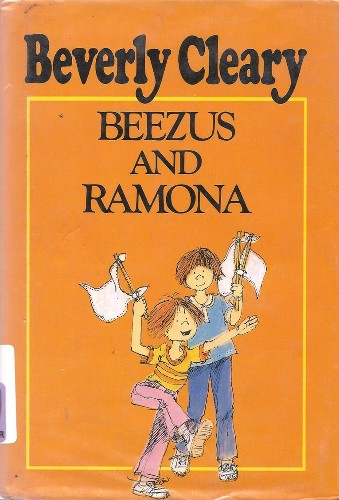
Children’s books probably provide a richer seam for quality costume work, tending as they do, to be heavily people by Wizards,Vampires,Pirates, Talking animals and the like. I think I could rock a Worst Witch costume, and I was very fond of her as a child. In our younger days, my sister and I did bear more than a passing resemblance to Beverly Cleary’s utterly brillant Beezus and Ramona so that’s an option (and no, I’m not offering you a picture of our younger selves for comparison.)

Beezus_and_Ramona

Fantasy fiction must also provide good dressing up opportunities. Terry Pratchett gives you exciting options of wizards, witches, vampires, policemen, vampire policemen and trolls. A troll suit might be tricky to build though, so maybe not.

I think my fantasy dress-up pick at the end of the day is going to be a bit of a classic. I’m going to go Jane Eyre.

Jane Eyre

Now I know she’s billed as being a bit plain, which isn’t ideal for dress-up, but I don’t think I can bring myself to abandon Jane for one of those flightly Austen heroines just in the name of prettier hair. Jane it has to be. Sensibly attired, unflatteringly centre-parted but resourceful and intelligent. Go Jane! Go Jane!

So what about you? Remembering  that it’s still last Thursday, who will you be dressing up as for school today?

In which I get quite het up about social mobility, and the lack thereof

So I’m 1 day (or 8 days depending when you’re counting from) late with the blogging. Apologies. I’ve been busy. There was work. And my dog ate my blog post, or it was stolen by pixies or vultures or something. There was a reason for my ineptitude I’m sure, and it almost certainly was not my fault.

I’m here now though. So that’s all right. And I’ve been thinking about poverty. Poverty is, when you put your detached academic hat on, a bit of a tricky concept. Do you measure it relative to a national or global average or do you maintain an absolute measure of poverty for a particular country or region? When and how do those measures change – if it’s in line with inflation, then who’s preferred measure of inflation should you use? Should it be one that places high emphasis on the cost of essentials (eg. utilities, rent, basic food) rather than “luxuries,” on the basis that a higher proportion of a poorer person’s weekly budget is spent on essentials than for a better off person? It all gets a tiny bit complicated.

There are some things we can say for definite about poverty in the UK though. Both Save the Children and Oxfam consider it UK poverty to require charitable intervention. The Institute for Fiscal Studies predicts an 300000 increase in children living in absolute poverty between 2010/11 and 2020/21. They also  predict an increase of 700000 working age adults living in absolute poverty over the same period. The Trussell Trust currently run over 250 foodbanks across the UK, providing essential food to people who can’t afford to buy it.  At that point it ceases to matter how you academically define poverty – when you’re relying on a charity to eat, you don’t need a nice man with a questionnaire to tell you if you’re poor.

And in a sense, so what? Some people are better off than others. This is hardly news. What makes me cross though, is the absolute breakdown in the ability to shift from “Have Not” to “Have”. In some, probably imagined, rose-tinted past, it’s reassuring to think that we believed that if you worked hard it was possible to better oneself. It’s getting harder and harder to believe that.

There is a gulf between the richest and poorest in our society. In 2009 the top 1% of UK earners earned a higher percentage of the total national income than at any point in the previous 50 years. In 2011 the OECD found that the link between parents’ income and child’s income was stronger in the UK than in France, Italy, the USA, Canada or Germany. Wealthy people have wealthy mummies and daddies.

It’s ok though. Our lack of social mobility is being taken in hand. Nick Clegg has a strategy. This is disheartening in itself. Deputy Prime Ministers develop strategies on things that aren’t quite important enough for the Actual PM to bother with them, or for there to be a government department and minister responsible for. Deputy Prime Ministers are places for parking issues where you sort of feel you should probably do something, but where actually doing something might be tricky or expensive, or tricky and expensive.

And in the meantime, we continue to talk about people living with the day to day problem of scrimping on food to feed the gas meter, or arguing with the Tax Credit Helpline about yet another mistake in their calculation, or trying to explain to the children why they can’t go to their classmate’s birthday party because you can’t afford the bus fare and the obligatory gift, as scroungers or shirkers. The language of many politicians is still steeped in the notion that if you’re poor, it’s your own fault, while never acknowledging that if you’re rich, there’s a pretty good chance that that was entirely down to daddy.

And that is my rant for today. I hope I’m wrong about the Deputy PM’s strategy. I mean, I’m not, but I hope I am.

In which I am writerly for the 2nd week in a row

Well, you can wait for months for a writing-related blog post around here, and then two come along at once. So after getting all researchy for my novel in progress last week (thanks to everyone who offered their own memories of being a 1960s teenager in the comments), today I’m thinking about writing shorter stuff.

I used, way back in the mists of time when I was fresh-faced young creative writing student, to write quite a lot of shorter pieces. I dabbled with both poetry and short stories, with fairly limited success. When I decided, back in 2009, that I wanted to Do Novels, I pretty much stopped writing short things. More recently I’ve started again, mainly with short stories – I am so definitely not a poet –  and I’m trying to work out the best approach.

There are gazillions of places that writers can submit or showcase short stories and poetry. There are big competitions, little competitions, print magazines (although sections of that market are shrinking rapidly), e-zines, writing blogs and spoken word events. So what’s the best line of attack? Should one just write stuff that you think is good and interesting and then look for a outlet for the piece? Or is it best to target specific competitions or publications?

One story that I did have success with, winning a lovely shiny little cup, was written specifically for that competition, but that was a competition with a specified theme. Others are more open, so perhaps have less requirement for the writer to write something specifically for that competition.

Another big potential outlet for short pieces of writing is Spoken Word events. These seem to have got more and more popular over the last couple of years, to the point where I, at least, can barely leave the house without someone shouting their poetic offering at me. I find spoken word events tricky though. For me, there’s a big difference between a piece of writing that works well for an individual reading it off the page, and a piece that works as a verbal performance.

Attending Spoken Word evenings I’ve sat through plenty of pieces that might have been just fine to read quietly to oneself, but which all but died on their author’s poor tired feet in performance. So, for me, Spoken Word events are something that, if I choose to do them, I have to write something particular for.

So, how best to target one’s writing resources? Is it better to keep one’s eyes on a single goal – for me that would be novel writing – and exclusively focus on that? Or is it better to pick out and target specific short story competitions to build experience and profile (and if you’re lucky get some prize money)? Or should writing be a purely creative endeavour where we write what we love and look for somewhere to submit/publish it later? What do you think world?

In which I think about research and try to get better at talking about the book

I am now 18000 words into novel number 2. This is particularly exciting because about half of those words have been bashed out in the last ten days or so, marking an stratospheric increase in the pace of progress. It also means that I’m having to get my head around the new challenges of book 2, as compared to book 1.

Book 1 was set between 2002 and 2013, and occurred entirely in places where I have actually lived. There was a tiny bit of research involved in making one character, a mathematician, sound like he knew what he was talking about, but that came down to getting a couple of books from the library and reading them. Not too onerous, even for a naturally workshy animal like myself.

With book 2, however, I’ve set a whole section of the story in 1967. Now 1967 isn’t like 1867 or 1267. We’re not into massively unrecognisable “past is another country” territory, but we are ten years before I was born. I’ve shifted into writing about stuff that I don’t remember, and I didn’t live through.

Even though it’s only 46 years in the past, there’s a surprising amount that I don’t know. I need to find out about homes for unmarried mothers, and the Abortion Act, both of which require in-depth research. But it’s not just the big things that form stumbling blocks. In many ways it’s the smaller details that are trickier to make authentic. What did 17 year olds who wanted to look cool drink in 1967? Has the legal driving age changed since the 1960s? What did a pharmacist’s shop look like in a provincial town in 1967?

I’ve tried to make it a little bit easier for myself by setting this part of the story in a place I know really well – the town where I grew up. That’s tricky, in its own way, too. I have to keep checking when certain buildings were built, when they started being used for a particular function, whether it was possible to walk directly from a to b via that route in 1967, as it was in 1987 when I was growing up. Now you might say that that doesn’t matter, that you can fiddle with those details in the name of fiction. And I would say you were right, but, as the writer, I feel like I need to know which details I’m altering and which are absolutely right.

So be warned, any of you who were bright young things in the mid-late 1960s, expect to get badgered with lots of inane questions about your youth when next we meet. And please accept my apologies in advance for how completely annoying that is likely to become.

The other writing challenge I’m working on at the moment, is trying to get better at talking about my work. Writing a novel is such an unbelievably solitary experience. You find yourself living in your own head with only made-up people for company for big hunks of time. Those made up people are often delicate, and prone to damage if brought out and exposed to critical gaze too early or too often. (More thoughts on that quandary here.)

And when you’ve written the thing you have to go out and try to sell it. You have to be able to explain what it’s about in as few, and as interesting, words as is possible. You also have to be able to talk to friends at dinner parties, and in bars, without running back to your husband and hiding when they ask about your writing. Not that I do that. At all. Ever. Very often.

I do find the ‘talking about it’ part of writing incredibly difficult though, simply because you spend so long writing and creating a world, that then discussing it with other people feels like stepping out of the writing bubble into a dark and jagged place where people might tell you that it sounds crap. And that is a wee bit scary. So I’m going to try to offer you a very occasional blog about what I’m writing as a sort of gateway process into actually talking about it to real physical human people. This was the first one. I hope you enjoyed.