In which I become a little bit hermity

Ahoy dear blog readers and welcome. I say welcome. What I actually mean this week is more along the lines of ‘The key’s under the mat. Let yourself in,’ because despite appearances to the contrary I am not here. I am actually writing this three days ago, because this week (by which I mean the week you are currently really in as you read this, which from my time-travelling blogger point of view is actually next week) I am officially a hermit.

There are reasons for the hermitage, and happily they don’t involve the concealment of any sort of embarrassing facial growth. Indeed, if I were possessed of a facial growth I would probably be posting pictures of it and asking for your best internet-informed medical opinions on how to proceed. Actually going to the doctor is so terribly time-consuming don’t you find? Anyway, the hermitage is for reasons of writerlyness. Not reasons that involve a deep yearning in my soul to retreat into a quiet and reflective artistic space and commune with my muse. That would not be practical. That last time I saw my muse he was sitting on the kitchen floor weeping and eating Philadelphia with his finger directly from the tub. He’s a terrible muse. I’m thinking of returning him to the seller – that is, I suppose, just what you get for buying a secondhand muse on ebay.

Anyway, the writerly hermitage is being undertaken for reasons of simple pressing need to just get the next book written already. There is a point in the gestation of most books where the writer decides the idea is awful, the writing completed so far is unmitigatedly terrible, the plot is unbelievable, and there is no imaginable way to fix these problems. Generally speaking, at this point, the writer will also believe that this is absolutely the first time that they’ve felt like this, and that it is definitely not ‘just a phase.’ I am in that ‘phase’ (well I say phase, it’s really really not a phase this time…) at the moment.

When I talk to other writers who are in that phase (because, obviously, when it happens to other people it is just a phase), I tell them, quite bossily, to stop being a moaning-minny and jolly well buck up and carry on writing. This is harsh but entirely good advice. I know it’s good advice because it’s been given to me by other much wiser and cleverer writers. And this week (also known from my current point of view as next week) is when I put that into practice. I’ve created myself a little writing retreat at home. Engineer Boy has been banished.* Groceries have been pre-ordered. All the good telly has been set to record. This blog post was written some time in the past. I have absolutely no excuse not to get my bum on my chair, my fingers on my keyboard and bang out some words. My target is 25,000 words in 5 days, which is ambitious but doable. That will get me to well over 60,000 words of novel which is probably about two-thirds of the whole. Hopefully that will be enough to get me past this hump and onto the home straight. Wish me luck.

* Not actually banished. Just on a course to learn to be a Better Engineer Boy.
In which I suggest some ways in which you can help a struggling writer

When’s the last time you did something to help the struggling author in your life? I’m assuming you all have one. If you’re not sure whether there’s a struggling author in your social circle just look out for the person wearing pyjamas in the middle of the day. The one who doesn’t look like they’ve washed their hair yet this week, and who prods you lightly when you talk to them because they’re not used to the voices they hear coming out of a real physical person. If you’ve got someone like that in your life, chances are you’ve got yourself a writer. Or possibly just a crazy person. Either way, I imagine you will be very keen to help such a person out. And helpfully, I have some easy suggestions as to how you might do that.

1. If your writer is of the published variety, just buy the book. If they’re not published, please try to desist from asking them when the book comes out. They may find dwelling on the subject disheartening and you may find the bit where they growl at you and try to rend their pyjamas a wee bit socially awkward.

2. Once you’ve bought the book, things can go one of two ways. Either you will like the book, in which case tell your writer you liked it. They will get embarrassed and socially inept, but they will appreciate it. If you really really don’t like the book, lie. Seriously, lying is fine. You’re talking to somebody who makes stuff up for a living. The lines between reality and fantasy are already pretty fluid.

3. If you really actually did like the book, write it an Amazon review. I know. It’s time consuming and you have to try and think of something to write, other than, ‘Yeah. It was good. There were words and stuff,’ but the reality is that Amazon is the all-encompassing big brother of book sales these days, and good reviews sell books, and selling books is what allows your pet writer to buy new pyjamas and proper non-supermarket-brand hobnobs. These things are like fresh hay and a lovely nosebag to the struggling writer. They will make your writer happy.

And that’s how you look after a struggling author. Indeedy. Yes.

So, just hypothetically if any of you were thinking you fancied buying a book, Much Ado About Sweet Nothing is still just 99p until the end of January. Totes bargainissimo.

In which I am drawn into a blog chain

Last week Sally Jenkins invited me to join a writerly little blog chain. Sally is a writer who specialises in shorter length fiction and the odd article. Two of her story collections have been published on Kindle and she is currently kicking her 2013 NaNoWriMo script into shape. She’s also a member of the Romantic Novelists’ Association Birmingham Chapter (yes, we call our local groups ‘chapters’ – do you see what we did there?) and is thoroughly charming, so who was I to say no?

There are four writery questions I’m supposed to answer, and I shall do so forthwith:

1. What am I working on?

At the moment I’m working on my second full length novel, which will, with luck and a bit more writing the book and a bit less skiving off to write blogposts, be published by Choc Lit sometime in early-mid 2015. Following on from Much Ado About Sweet Nothing (which, just for your information and not implying you should all go and buy it immediately at all, is in the January kindle 100 deal and is, therefore, 99 tiny pennies at the moment) I wanted to write another Shakespeare adaptation. I love writing adaptations – I like the slightly analytical/puzzley element of working out how to take a story apart and rebuild it again in a different form. This time I’m having a go at A Midsummer Night’s Dream. It’s an amazing play – all the action takes place within 24 hours, and there are feuding fairies, and star-crossed lovers, and a guy who gets turned into a donkey. All of which makes it a prime candidate to be reset in a low-grade, early twenty-first century, midlands university. I hope.

And then after that I’ll be straight into writing the sequel to Holly’s Christmas Kiss, which should be ready to come out as an e-novella this Christmas.

2. How does my work differ from others of its genre?

Well there’s the Shakespeare thing for starters. But what I try to do more than anything else is write about love, rather than romance. Weirdly, perhaps, for a romance writer, I don’t really trust romance. Sweet words, and big gestures are easy. Love though, can be really hard. Real people are annoying and react unpredictably and do stupid stuff and hurt people they care about and then quite often make it worse while they’re trying to fix it. I’m much much more interested in all of that than I am in eyes meeting across crowded rooms. Having said that, my Christmas stories do tend to be a bit more traditionally romantic – well, you know it’s Christmas!

3. Why do I write what I do?

I write stuff that I would want to read. So far I’ve mainly been writing romantic comedy, but I wouldn’t rule out a switch of genre in the future. I love to read chick lit, sci-fi, more literary stuff, occasional historicals and I’m even starting to get into odd bits and bobs of crime, and I think lots of readers are the same. So never say never to writing something completely different – I have a back-burner project which is a more literary timeslip story that I definitely intend to get back to one day. At the moment though I’m signed with a romance and women’s fiction publisher (the utterly fab Choc Lit) and I’m really happy writing in that genre for the forseeable future at least.

4. How does my writing process work?

Procrastinate a lot. Write a little. Procrastinate a lot more. Write a tiny bit. Realise I need to get whatever I’m working on finished by about two weeks ago at the latest. Panic. Write a lot. Panic a bit more. Cry. Reread what I’ve written. Have huge crisis of confidence which I’m convinced is a completely different to all the crises I’ve had previously. Reread again. Edit. Submit to publisher with long apologetic email about how crap the manuscript is. Click refresh on email obsessively until publisher replies saying she’s sure it’ll be fine. Promise self I’ll definitely make a start on the next book while I’m waiting for the edits and revisions to come through. Procrastinate some more. Get revisions from editor. Deal with those straight away (I’m one of those freaky writers who prefers editing to writing – weird I know). Deal with copy edits and proof reading queries, again with only mild procrastination at this point. Realise that there is now absolutely no excuse not to start on next book. Procrastinate a bit more. Repeat process from beginning.

I’m not saying it’s efficient, but that is a pretty accurate description of my ‘artistic process.’ Oh dear.

So that’s me as a writer in 4 easy questions. And as this is a blog chain I’m supposed to have identified 3 more writers to carry it on. Er… oopsy?

So all that remains is to remind you  again (with huge apologies for the promoyness) that Much Ado About Sweet Nothing is just 99p during January (or $1.63 for Americans). Trust me – it is really rather jolly, and has a slime mould and a big white wedding. Something for everyone there, I’d say.

MAASN_small final cover

In which I undertake the traditional resolution making for the year ahead

Hello. Good morning and ahoy there my hearties. Welcome to 2014. I trust you have found it to be conducive to good cheer and ever so lightly flavoured with cinnamon so far, apart from the thing about it being flavoured with cinnamon. It’s a year. Years don’t really taste of anything, with the exception of 1994, which I think we can all agree was a more than a little bit minty.

Anyhow, given that that whole train of thought had somewhat got away from me, I’ve made the executive decision to start a brand new flavour-free paragraph so that we can all just move on. It is, as I believe I may have been wending my rather circuitous way towards saying, a whole new year, and traditionally at this point in the calendar I make a number of resolutions. Broadly speaking they are threefold:

1. Lose weight

2. Get over the driving phobia

3. Write more/better/more profitably/preferably all of the above.

And all three of those resolutions definitely apply this year, on account of how I totally failed to achieve 1. and 2. last year, and although there were some definite writing achievements in 2013, there is always further room for improvement. That means that my resolution making is a rather quick and speedy process. I’m pretty confident that I’ve got those resolutions locked down to come around every year for at least the next decade, which is marvellous because it frees up time and head space to get on with doing and achieving random things that you’d never think to aim for at the start of the year.

Last year, for example, although I had definite good intentions in the area of writing, I hadn’t thought of ‘Become the Cliff Richard of the kindle novella market’ as a specific aim, but I still managed to tick it off, when my little Christmas romance novella, Holly’s Christmas Kiss, went to no 1 in the Kindle short story chart and stayed there until Christmas Day. I had an actual Christmas Number 1. I shall now mainly be hanging out with the previously mentioned Sir Cliff of Richard, Noddy Holder, and that prison guard lady off of X-Factor.

Having your basic resolutions nailed down also gives you plenty of spare brain-time to really finesse your plans and systems for how those resolutions might be achieved. So far as the losing weight goes, I have constructed the most marvellously convoluted diet plan which involves dieting for 6 months in 3 week bursts over a 2 year period. And the worrying thing is that I totally have a rationale for why that is a good idea, based on actual science (or at least on things I have heard actual scientists say on telly, which I suspect might not be quite the same thing, but still, a plan is a plan so I’m sticking with it).

I also have a plan for the writing stuff to be done this year. It involves finishing one and a half novels and a novella, and getting back into teaching creative writing and offering workshops, and possibly a critiquing service for new writers. It’s almost certainly completely unrealistic, but I have a spreadsheet with all the different things I’m going to do marked on it and highlighted in a range of pretty colours, and making the spreadsheet was useful and not really procrastination at all.

So that just leaves the driving phobia, which is the only one where I don’t have a plan, beyond ‘try to sit in the driver’s seat without crying.’ Oh well, there’s always next year.

So, as I always ask you at this time of year, what are your resolutions? (And also, any of you who are budding writers please feel free to wave a hand via the Contact Me page if you’d be interested in workshops or courses at all.)

In which I run around covered in tinsel singing Christmas carols at full volume

It’s Christmas.

Nearly.

It’s certainly Christmas enough to start decking your halls, resting your merry gentlemen and generally stockpiling alcohol like there’s an unprecedented sherry shortage about to hit.

I love Christmas. Some people don’t. Some people say things like, ‘Well it’s just for the kids really,’ and complain about things like the appropriation of Christian tradition for commercial purposes, or the appropriation of ancient pagan tradition for Christian purposes. Some of those people may have a point, but they’re still fundamentally wrong-headed. Christmas is not the time for rational argument and making a valid point. Christmas is the time for Noddy Holder, and playing parlour games the precise origins of which are lost in the mists of time but will inevitably lead to an argument with your grandmother about whether The Gingerbreads were a real pop band.

Christmas is also the time for reading, and writing, a particular type of story. Writers have been inspired by Christmas for generations. Ever since Luke sat down and penned that dynamite passage about a census, back in the days when Quirinius was Governor of Syria, writers have been writing about all things Christmas.

Dickens did it. Richard Curtis did it. Greg Rossen and Bryan Sawyer did it.* And lots of other very clever writers did it too. So in honour of Christmas and not wanting to look so terribly un-English as to just bang on about my own book, I asked some of them about their Christmas stories and what inspired them.

Kate Johnson has published two Christmas novellas, Elf Gratification (published as Cat Marsters), an erotic novella featuring gratification, and one assumes, elves, and a festive prequel to her Sophie Green series. Talking about the Sophie Green book, The Twelve Lies of Christmas, Kate said, ‘I sat and thought about what was great about Christmas: the good cheer, strangers wishing each other Happy Christmas, the special food and drink, time spent with friends and family, the presents, the bobble hats,  the decorations…the break from normal life. But what if you don’t have any of those things? Except for maybe the bobble hats?’

Jo Beverley has released, not one, not two, but three Christmas novellas. She told me that she loves ‘writing books set around Christmas because the celebrations often involve opening homes to company, which can bring people together who might not otherwise meet or reencounter,’ and added that, ‘the emotions around Christmas can also be stressful, which creates tension and conflict.’

Chrissie Loveday‘s Christmas novella, A Computer Guy for Christmas, is due out this week. She commented, ‘I adore Christmas! Our house is awash with lights, trees and all things Christmassy. Of course I wanted to write about it! What a perfect excuse to share it all.’ The story features an office party, and looks at the tension between spending Christmas with family and maintaining a budding romance.

So Christmas gives writers the chance to bring characters together, and throw a bit of stress into the mix, but also to sprinkle a little bit of fairy dust (and a lot of fairy lights) over their story, and incorporate as many bobble hats as they like. And this year… (SOUND THE KLAXON – BLATANT SELF PROMOTION ALERT) I joined in, with my festive romance, Holly’s Christmas Kiss.

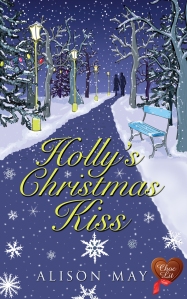
Holly's Christmas Kiss cover

Holly’s Christmas Kiss is a much sweeter, in some ways much more innocent, story that I normally write, but I adored writing it. I love the fact that at Christmas you can take off the good taste brakes and throw every single Christmas image you can think of into the mix. So there’s mistletoe and Christmas trees and and a turkey and Santa and presents and… well it’s pretty darn Christmassy. Anyway, you could read it if you wanted, or not. Merry Christmas one and all either way.

Right. Well now I’d best be off to baste my merry gentleman and try not to dismay my turkey. Toodle-pip.

* What do you mean ‘who are Greg Rossen and Bryan Sawyer?’? Why, only the creative geniuses (geniuii?) behind David Hasselhoff’s 2012 Christmas extravaganza The Christmas Consultant. Tsk at you for not knowing.

In which I have an actual book cover for the actual (virtual) book what I wrote

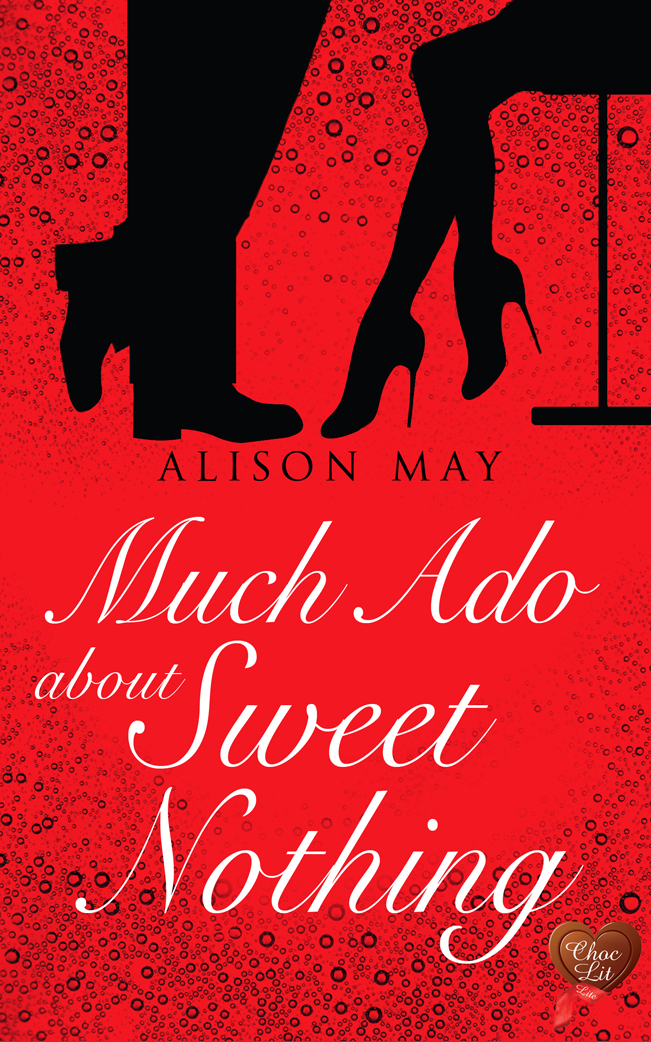
Ta dah!

So there is it. The cover for my first novel. The astute amongst you will also notice that it has a new title. The book formerly known as ‘Well it’s the book  I wrote; it’s sort of about love and maths and stuff and it’s based on a play,’ is now officially titled, Much Ado About Sweet Nothing. Weirdly, my publisher felt that worked better. Curious.

Anyway, there it is. My first book cover. Huzzah!

(BTW, if you want a bit more of me wittering about romance writing related stuff, I’m on the Choc Lit authors’ blog today talking about What makes a hero: http://blog.choc-lit.co.uk/?p=5145)

In which I go on a writing retreat and it is all rather lovely

I got home last night from a two night writing retreat in deepest Devon. I’m rather proud of that sentence. While my publisher was busily winning Publisher of the Year, at the 2013 Festival of Romance (just had to get that in – yay Choc Lit!), I was on a retreat. Going on a ‘writing retreat’ really does sound like something that other, better, more grown-up writers would do. Proper writers with lots of writerly jewellery and a penchant for scarves and overusing the word ‘Darling,’ darling.

However, somehow I managed to slip under the radar and got allowed into to Retreats For You, on a tutored retreat with most excellent writer and Queen of the writing tutors, Julie Cohen. Retreats For You is an utterly brilliant place, run by Deborah Dooley and her partner, Bob. It provides a perfect little bubble in which to just do writing, with no distractions beyond the possibility of going out for a little stomp around the Devon countryside or wandering into the kitchen and snaffling another piece of flapjack. So my weekend was all open fires and literary thoughts…lounge-150x150

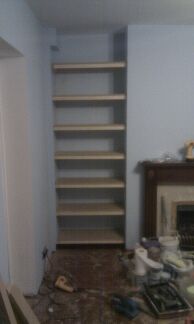
while, Engineer Boy stayed home and built these:

Now I need to buy more books

Apparently, these are just to store the insane number of books, I already own, rather than an excuse to buy tonnes more. We shall see…

Anyway, back to the retreat – Julie provided a counterpoint to all the lovely, comforting, warmth that Deborah offers, with her usual tough love approach to writing critique. Julie is not the right writing tutor for you, if you want to be patted on the head and told that everything you’ve written is brilliant. If you want to make the sodding book actually work and get written, she’s bloody marvellous though.

I’m in the early stages (about 25k in) of novel 2 at the moment, with novel 1 scheduled to launch into the world in the next few weeks. And I won’t lie. I’ve been struggling. Writing your second novel is an odd process. You know so much more than you did when you started novel 1, but that additional knowledge can be paralysing. It means that you see all of the problems as you’re writing them, so, rather than just bashing out a shoddy first draft which you can revise later, you get caught up trying to fix the problems as you go along and end up not really progressing at all.

Sometimes what you need at that point is a fresh pair of eyes to look at you sternly, and remind you to keep it simple and try not to actively turn your protagonist into an entirely unsympathetic psychopath. With novel 1, I can pinpoint the moment when it shifted from being an idea, into being a potential book. It was a conversation in a tutorial with my university tutor, Deb Catesby, where we talked about characterisation ideas. It sounds like a very minor point, but that was the point at which I decided that Ben, the hero, would be a mathematician. That decision defines how Ben sees the world, which defines how he interacts with the heroine, Trix, and how she then responds to him. It also gives the book it’s theme: Nothing & Everything (or for the maths-minded amongst you Zero & Infinity).

I think (although it’s too soon to be sure) that I had the equivalent of that conversation this weekend. Julie helped me to work out what my protagonist’s fundamental character needs are. Before that conversation I knew what the plot required her to do, but I hadn’t got clear why she behaves in the way that she does. Without that why, it’s almost impossible to give her the emotional depth she needs to make the reader empathise with her situation and behaviour.

Writing is a generally very solitary endeavour. That is part of the reason that we value organisations like the Romantic Novelists’ Association, that give us chances to change out of our pyjamas and interact with real people, so highly. It’s also part of the reason that we get so addicted to twitter and facebook. It makes a nice change from only talking with made up people. Sometimes though, you need to step away from your laptop and find a fresh brain to bounce ideas off, and you need that to be a person who’ll tell you honestly if they think you’re going the wrong way.

So, in summary, hurrah for Deborah Dooley and Retreats For You. Hurrah for really good writing tutors – Julie and Deb. And now, hurrah for getting one’s head down, stopping procrastinating, and just writing the bloody book.

In which I think about the difference between real-life and makey-uppy

‘Fiction makes sense and real life doesn’t.’ The very clever and lovely Julie Cohen has just announced that to me out of my computer (via Writers’ Web TV – she doesn’t actually live in my computer, I don’t think). And that thought set off a little ping inside my brain because I’ve been thinking about that very question of the distinction between real life and makey-uppy a lot of late.

I’m currently working with my delightful new editor on the final tweaks to Sweet Nothing, which, barring last minute delays, will be out in the world next month. And I’m starting to think seriously, for the first time, about the fact that people might read it. Realistically, as it’s a debut novel by a total unknown a high percentage of the people who read it will be friends or acquaintances. And at least some of those people are going to read my story of a bickery and weirdly dysfunctional relationship between a nerdy thirty-something year old man and an artsy-literary woman, and they’re are going to look at myself and EngineerBoy and they’re going to make a fairly obvious assumption about where the inspiration for those two characters came from.

And when they do that I will huff and puff, and get offended and bang on about how it’s obviously fiction and it’s not based on real life, and I shall probably say that it’s shows a lack of imagination to assume such a lack of imagination on the part of the writer. And when I react like that I shall be at least half right.

But actually it’s a little bit more complicated than that. Those two characters absolutely aren’t based on EngineerBoy and me. I can’t, personally, think of anything more skin crawling than consciously and intentionally typing out the details of your most intimate relationships and then sending them to a beta reader and an editor and then out into the world. I feel faintly exposed just typing the notion onto this blog. Developing and writing those characters, I didn’t start by thinking about any real people. They, and all the characters, are absolutely the product of my imagination.

However, my imagination is absolutely the product of my environment. What I imagine about how relationships work is entirely borne out of my own relationships. All the characters I write are products of my overcrowded, butterfly brain. It’s all completely made up, but I can only make-up what I can make up and that is bounded by the life I’ve lived and the people I know. So it’s kind of a circular problem. The characters I write and the stories I tell are definitely made up and definitely aren’t based on real life, but they’re made up out of my imagination, which is sculpted and defined by my real life, and round and round and round we go.

So, if you are so kind as to read Sweet Nothing when it comes out and you think you recognise a person or a place or an incident, don’t be scared – I promise that it isn’t you, or at least, if it is, I don’t know that it is, so there’s no need to feel weird. And here end my random writerly musings. I shall return soon, when hopefully Michael Gove will have annoyed me in a new and interesting way and I’ll be able to get a proper rant going. I’ve not had one of them for a while…


In which a dead twelfth century monarch inexplicably goes street

A funny thing happened to me this afternoon. I was drafting a short story for 42-Worcester, a local spoken word event focusing on the ghoulish and the speculative end of fiction. It’s an event I go along to quite often but very rarely perform at, because I tend to write novel length frothy romance, which wouldn’t quite be ideal to read aloud in a ten minute slot at a sci-fi and horror night.

Anyhoo, next month I’m down to perform and I was whipping together a little ghostly delight to share with the group; I alighted on the idea of writing about the ghosts of Worcester Cathedral focusing on Prince Arthur, the elder brother of Henry VIII, who is buried in Worcester. All was going swimmingly until the ghostly Arthur struck up a conversation with the even more longevitously deceased King John, and the dead twelfth century monarch starting talking like a 1990s rap wannabe.

“Wassup bro?” he said. This startled me somewhat, not simply because that’s a teeny bit anachronistic for a man of regal birth who died in 1216, but also because I had no idea he was going to say it, and still have absolutely no clue why he did. That is very very wrong. Ghost King John is fictional. He exists only inside my head. He should not say things if I don’t know why he’s saying them.

There is with writing, as with pretty much all creative endeavours, a sweet spot, where you get into a groove and the words just flow without very much conscious thought. It’s a beautiful and liberating thing. It happens, for me at least, for about five thousand words of an eighty thousand word book. The rest is sheer effort, but you stick with it in hope of alighting upon another few hundred words of magic carefree writing bliss.

King John going all street was beyond that though. This was a line that I typed with my own typing fingers which are attached to my typing arms which are attached to my shoulders which are attached to my neck which is attached to my head, which puports to contain my brain, and as soon as I’d typed them my brain yelled, “What?”

Ghost King John had properly gone rogue, beyond the control of his author. There are reasons history remembers him as Bad King John, and I’m increasingly convinced that an unwillingness to conform to his designated character arc is probably one of them. Bad Bad Fictional Ghost King John.

So that was weird. I mean, it’s totally fine. I can just go back and delete him. That’ll show him who’s in charge around here, but it leads me to a question for the writers out there – what do you do when a character goes rogue? Go along with it for the ride, or briskly reign them back onto the plan?

In which I witter on about self promotion and sisterhood

Ahoy, hello and indeed howdy one and all.

Reading it back I suspect that was probably a greeting that needed more commas, but I can’t quite work out where to put them so I’m going to move on and hope nobody noticed.

Right.

I’m also going to skip over my normal paragraph about being a bad blogger and promising to eat my bloggy fibre and be more regular in future. Best laid plans and all that…

So, anyway, this week I am mainly thinking about self-promotion. It’s a bit of a tricky topic for us budding writers out here in InternetWorld. If you hop over to Twitter you will find that the only form of tweet even nearing the ubiquity of “Buy my book,” is the humourous ranting tweet about the number of tweets saying “Buy my book.”

In addition to the relatively benign “Buy my book” tweeters, you also get the real hardsellers who send DMs (private one-to-one messages on twitter) instructing you to buy their book and write an amazon review, or demanding that you like their facebook author page. Those people are beyond the pale and should be rounded up and taken away to a place where someone can have a stern word with them and then they can sit for a bit and think about what they’ve done.

All of which is a bit tricksy for us writerly types, because ultimately we do want you all (every single last one of you) to BUY THE BOOK. Fortunately, I am here to save budding writers from this nightmarish social media stressfest, with my completely considered, not made up on the spur of the moment at all, RULES FOR ONLINE PROMOTION.

1. Tweeting or Facebooking a single line from your novel won’t make anyone buy the book. No single sentence is that amazing. If Shakespeare had been @shakespearebard and had tweeted “‘To be or not to be’ Brilliant new story: HAMLET! Out now ” he would have essentially managed to make Hamlet sound a bit meh. Bad Shakespeare. And Bad Twitterers. Bad.

2. Don’t tweet or message me just to ask me to like your Facebook page. Have a facebook author page by all means. I’ve got one. It’s fine and dandy. It means that you can keep your personal facebook and your public/work/writerly facebook separate. But the point of having it isn’t just to attract likes. Presumably the point of having it is to allow you to engage with readers in a fun interesting way that ultimately encourages them to BUY THE BOOK. Putting all your energy into getting likes for a facebook page seems like putting your cart before your horse, which is stupid because horses are notoriously poor at pushing stuff. Facebook likes aren’t an end in themself. Remember that people.

3. It is ok to tweet or retweet links to reviews, blogposts and news stories about your book, but it’s not ok if that’s all you tweet or all you put on facebook. Twitter’s tagline is “Join the conversation,” not “Shout promotion at strangers.” For every explicitly promo-y tweet set yourself a target of at least three tweets about your breakfast. Everyone loves breakfast. No-one loves having promo yelled at them across the interweb.

4. Be interesting. And if you only adhere to one of these rules, make it this one.

So in summary, facebook author pages are like horses. You need to be careful about where you put your cart, and be interesting. That is all dear readers. That is all.

Actually no, it isn’t! I’m not usually a fan of blog chainy type things, for similar reasons that I’m not really a fan of blog awardy things, which I explained back here. However, this week I was tagged in this:

by the rather lovely Jane Lovering, and the concept didn’t actually offend me so I shall play along. The idea is that we’re sharing the love between cool and interesting women bloggers who we admire. Jane has already tagged my fellow Choc Lit newbies, Rhoda Baxter,  Janet Gover and Jules Wake, and so I’m going to add the following:

Laura E James – one more Choc Lit Newbie. The Dear Mum post on 22nd July made me tear up.

Holly Anne Gets Poetic – in the interests of full disclosure I’ll acknowledge that Holly is a close personal friend, but she’s also my absolute favourite poetry blogger out there at the mo’. Read her. She is funny and dark and wise.

Neets Writer – I’m not normally a fan of writers blogging about writing. In fact the amount of writing chat around here at the moment is quite putting me off myself. But Anita Chapman does it well – she’s worth a read.

Kate Johnson -And one more Choc Lit girl to finish things off. The delightful Kate Johnson, who I have just about forgiven for taking MY little cup home from the RNA conference this year. Apparently she won it or something…

And that really is all. Bye bye.