In which I muse on London Book Fair

Last week was London Book Fair, the UK’s annual gathering of the publishing industry where agents, publishers, and booksellers come together and do vast amounts of publishing industry type stuff. Essentially LBF is a massive trade fair, where agents and publishers tout their wares. Rights sales are the main order of business, and it’s a thoroughly busy and buzzy place to be, but the wisdom in times of yore was that LBF was most definitely for business not for actual writers.

Recently, however, the good people behind LBF have been making a concerted effort to lure more authors along, setting up a section of the show headed ‘Author HQ’ with specific events aimed at writers rather than publishers or agents. This year, for the first time, I bought a ticket and headed to the Big City to see what it’s all about.

So was it worth it? Well, yes and no. I had a fun time. I went out for lunch with my publisher and editor, and a fab group of authors who either write for Choc Lit as well or are chums through the Romantic Novelists’ Association. It’s always nice to go out for lunch, and it was particularly nice to meet my editor, who, despite have worked on for four separate books, I’d never actually met in real-not-on-the-internet-life.

I also went to a Dragon’s Den style pitch-the-agent event where ten very brave authors pitched their books to a panel of agents and editors in front of a live audience. It was interesting to see the sort of feedback the agents gave, and also hugely impressive to see the authors involved lay themselves and their book-babies out for criticism so publicly. However, I’ve been to a number of talks by agents and editors, and I follow quite a few industry blogs (Lizzy Kremer’s Publishing for Humans is my current favourite) so there wasn’t a huge amount in the feedback that was unexpected.

Apart from that the Author HQ talks I saw were fine, but at a fairly introductory level. There would probably be some interesting stuff for new writers trying to decide whether to pursue a traditional publishing route or self-publish, but for as an already published author looking for progress my career further still, I didn’t find a huge amount at Author HQ for me. So my personal conclusion on LBF for writers: go if you think the price of the ticket is worth it for the buzz alone, but it’s probably not the best place to pick up information and ideas for developing your writing or writing career. Personally, I think I’d probably only be tempted to go again, as an author, if I had a specific must-see event to go to, or specific people I needed to meet. Of course that’s just my opinion- here’s an alternate view from Liz Fenwick.

So that’s London Book Fair. ‘What other interesting events for writers are coming up?’ I hear you ask. Well, it’s jolly funny you should ask that, because I myself am in the process of plotting an awesome event for developing writers. This October, I’m teaming up with Janet Gover to tutor a weekend writing retreat at the beautiful Farncombe Estate in the Cotswolds. There’ll be lots of writing time, one-to-one tutorials, group workshops, and the price also includes your accommodation and plenty of lovely yummy food. The full cost of the retreat is £350, but if you book in before the end of May we’re offering a 10% early booking discount, so you pay just £315. All the details and the retreat booking form are here. It would be lovely to see some of you there.

In which I participate in a Lovely Blog Hop

Last week I was tagged by Berni Stevens to take part in the Lovely Blog Hop. Normally I’m not very good at participating in blog hops. They involve remembering to post on an agreed day and only talking about the subject at hand, neither of which are my special blogging skills. In this case though, the blog hop is officially Lovely, and everyone likes Loveliness, so I thought I’d give it a whirl. It’s all about the Lovely things that have made me the person, and the writer, I am now. Aw.

So here are my thoughts on a number of areas of potential Loveliness.

First Memory

Now my first clear memory is very specific, but not particularly lovely. It’s of a family holiday in Oban where it rained a lot and, having walked boldly into town, my mum and dad decided to get a taxi back to our accommodation because of the downpour. I have a very distinct memory of the taxi driver being a middle-aged slightly balding ginger man – picture a Scottish Neil Kinnock with a taxi. So there you go – not a particularly lovely or unlovely memory, but true so it’ll have to do.


Books

An excellent heading for loveliness. I don’t remember ever not loving reading. Right from nursery school when that cat first sat on the mat, I think I was hooked. Although looking back now, the story of the cat lacks narrative drive. Why is it sitting on the mat? What impact does the mat have on the cat’s character arc? These things are never properly explored.

From then on I loved Winnie-the-Pooh, and later Enid Blyton – I always loved her boarding school books, whereas my sister was addicted to the ones where groups of small children catch smugglers. Then it was Sweet Valley High and Terry Pratchett, and then all the other books. All of them. So many books. So little time. Feels overwhelmed. Crawls back under duvet (with a book).


Libraries

The two formative libraries of my childhood were The Main Library in town where you would go with Mummy, and Scalby Library which my sister and I were allowed to go to on our own because it was nearer, and also, on the way to Grandma’s house. The Main Library had a children’s section that I remember as being massive. It almost certainly wasn’t. I suspect it was just a fairly normal sized room, but as Terry Pratchett fans know, books distort space and time, so that was probably what made it seem bigger.

Scalby Library was mainly notable for not having a public toilet, which for children who’ve walked there without adult supervision, could turn out to be problematic. On one occasion my sister, who was about 16 at the time, desperately needed to pee and persuaded the staff to let her go to their toilet by claiming that her little sister needed to go and might wet herself. I was 11. I did not need to go. This was most unscrupulous behaviour.


What’s your passion?

Writing (covered below). And reading (covered above). And education (covered below). And baking (not covered anywhere else, but it is an excellent way to achieve cake and so is therefore very lovely).


Learning

I love learning. Knowing more stuff is always excellent, and realising how little you know at the moment is excellent too, because it encourages humility and listening to other people, both of which are very very Lovely Things.

I think I’ve always loved learning, but I didn’t always love school. Secondary school, in particular, was fairly horrible, but I adored university so much that I went back and did an MA, and then a second BA, and then a teaching qualification. If tuition fees weren’t so prohibitively high I’d do another degree in a heartbeat. I fancy Law. Or maybe Politics. Or PPE. Or…


Writing

My earliest memory of writing was deciding, with a friend from school, that we were going to write, and star in, a satirical play about two rebellious schoolgirls who join a children’s choir. I definitely remember that we thought this play was going to be hilarious and would, almost certainly, change the world. We were about 10, and I don’t think we got past arguing over names for our characters.

So there you go – the important writing skills of a) having an idea and b) getting hung up on some tiny detail of the idea and never actually writing any words, were developed at a young age and have served me well ever since.


And that’s my Lovely Blog Hop Blogpost. Next week historical author Heather King will be taking up the baton on her own site and sharing her lovely thoughts and memories about what made her the writer she is today. You can also come back to this very blog right here next week to catch up on my 52 Weeks:52 Books progress with my update for March.

In which I pitch my awesome movie based on the super-glam life of the writer

Yesterday the lovely Tora Williams had a very marvellous blog post about the ridiculous way writers are depicted in films and on tv. That got me thinking. Tora is, of course, absolutely right. Actually being a writer involves hardly any old-fashioned typewriter work, very little moody staring into the middle distance wearing only outsized designer knitwear and your knickers, and hardly any fighting crime. I find that last part particularly disappointing – Jessica Fletcher lied to us all, and, I’m at least 85% sure, was also a serial killer. Doing writing in real-life involves zero crime-busting, and you’re only allowed to bump off the made-up people.

Anyway, as I said some time ago before I got distracted by serial killing, Tora’s post got me thinking. What would a movie depicting the realistic writers’ life look like? All the best movies (and most of the worst) follow a basic three act structure, so what would the key plot points in our writer’s life be?

ACT 1

THE SET-UP/STATUS QUO:

Hermione Scribbler is just a regular ‘girl next door.’ There’s nothing special about her. No indeed. She has limbs, and very often bothers to wash her hair rather than just tie it back and hope for the best. That’s just the sort of crazy chick she is. Go Hermione!

THE INCITING INCIDENT

Hermione is made redundant/goes on maternity leave/gets fired for inadvertantly instant messaging a picture of her boobs to the whole office. Whichever it is, the point is this Hermione has time on her hands. She is temporarily disheartened, but then it hits her. She will write a novel, and then she will be rich like JK Rowling and Dan Brown and Zoella.

Initially Hermione is a flurry of writerly activity. She makes a little home office space in the useless bit of dining room that’s half under the stairs. She reads A LOT of blogs and webpages about How To Write a Novel. She googles writing courses. She sets up Word to do first line indents and 1.5 spacing. She opens her new document and…

TURNING POINT 1

Hermione stops. What Hermione has omitted to come up with so far is an actual idea for a book. Hermione has a cake instead. During her cake Hermione has an awesome idea about a clan of cake-fetishist vampires. The plan to write a novel is Back On!

ACT 2

This is where our heroine’s situation becomes increasingly complicated and emotionally fraught. This is the sort of stuff we can expect to see:

  • Hermione gradually stops wearing proper clothes. They are pinchy, and you have to think about which ones go together. This is hard. Pyjamas are much much easier.
  • Hermione watches a lot of youtube videos. She tells herself this is research. It isn’t.
  • One day, in a moment of high drama, Hermione finds an interesting brown stain on her pyjamas. She sniffs it. It smells like chocolate. Hermione resists the urge to lick the stain for at least 14 seconds.
  • Hermione googles literary agents and makes a list.
  • Hermione spends a whole day planning her outfit for when one of those literary agents takes her out for cocktails. It is, after all, only a matter of time.

THE MID POINT/POINT OF NO RETURN

Hermione has a brief golden period of writing. Everything falls into place. The cake-fetishist vampires behave exactly as she wants them to. The words flow out of her fingerless-gloved writing fingers. It is a window of perfect joy. It’s lasts 27 and a half minutes and produces 417 words, 250 of which are terrible, but it’s too late. Hermione is hooked.

ACT 2 CONTINUES

  • Hermione joins a writing group and then makes plans to meet other members for coffee on a regular basis. This is important because spending time with other writers feeds the creative instinct. It is almost like actually spending time writing. Almost.
  • It strikes Hermione that there are also writers on twitter, who she can chat to without ever leaving her writing desk. That is definitely almost like actually spending time writing. Almost.
  • Hermione develops a tricky condition known as ‘writer’s bottom.’ She resolves that, in addition to definitely always writing 2000 words per day, she will also go jogging.
  • Hermione searches for stylish jogging clothes on the internet.

DARKEST MOMENT

Hermione realises that it is now quite a long time since she was made redundant/went on maternity leave/did the booby instant messenger thing. She also realises that at no point during this story has she had a baby, so it was almost certainly either redundancy or the booby thing. Whichever. The point is her money’s running out. The book isn’t written, and she needs to get a job. Or, thinks Hermione, she needs to get her head down and finish the novel which will then make her rich.

ACT 3

Hermione prints out pictures of JK Rowling, Dan Brown and Zoella and sticks them up next to her computer for inspiration. She is going to Finish the Book. Cue montage of frantic writing activity. This will mainly be marked by Hermione developing a wild eyed look and an increasingly lax approach to personal hygiene. Eventually she emerges from the writing pit with 93,000 words about her vampires.

CLIMAX

Hermione prepares her agent submissions. This involves writing a synopsis. Hermione cries a lot. Hermione thinks bad thoughts about setting cake-festishist vampires on whoever invented the synopsis. Eventually her first submission is ready to send. Off it goes! Followed by another, and another, and another.

RESOLUTION

Hermione waits for a reply. And then she waits some more. Then she gets a flurry of rejections, including one that says that although the cake-fetishist vampires aren’t right for the agent’s list, she would love to read more of Hermione’s work. Hermione fails to realise that that is completely brilliant and has a long cry. Later she finds a cornflake in her bra. She has no idea how it got there.

The End.

And if you’d like some slightly more practical tips on writing a novel, there are still a few spaces left on my Developing Your Novel workshop in Birmingham on 28th March

In which I reread an old classic

I’m currently rereading Emily Bronte’s masterpiece, Wuthering Heights. It’s probably the fourth or fifth time I’ve read the book – the first was when I was about 17, and the most recent was seven or eight years ago when I read it as part of my Creative Writing degree course. Having read it so many times and studied it at university I would have said, with confidence, that Wuthering Heights was a novel I knew pretty well, but here’s a newsflash from the current rereading: it’s absolutely nothing like I remember it. There are whole sections that I don’t remember at all, and some of the bits I thought I did remember are quite quite different from how I remembered them. This is odd, because it’s, obviously, still the same book. In fact, in this case, it’s physically, literally, actually the same book that I’ve read before, but the experience of reading it is completely different.

I think there are reasons for this, and I don’t think any of them are that aliens have come to earth and rewritten bits of Wuthering Heights, which is a shame, because that would have made an awesome blog post.

The non-alien related reasons are twofold:

1. I’ve changed

Well given that the book hasn’t changed, that leaves the reader as the only remaining variable, so if the thing I’m looking at isn’t different, but the experience of looking is, then that must be down to me. The things I’m picking up on during this reading are far more to do with the characters and far less to do with the brooding atmosphere and oppressive moor. This might be because I’ve moved on as a writer since I last read the book, and am currently fixated by character in terms of how I plot and revise my own writing. I’m noticing, for the first time, how complex, and essentially unpleasant, the minor characters are. Joseph, Nellie Dean, Mr Lockwood are all astonishingly self-involved in their own different ways.

I’m also noticing how dated the prose style is, and how slow the opening chapters are, which I don’t remember picking up on before. I’m actually quite impressed with my seventeen-year-old self for sticking with it. Again – that’s the writer in me coming through, and noticing deviations from the contemporary received wisdom about how to start and pace a novel.

It’s not the first time I’ve had a book change in front of me on rereading. I started Kazuo Ishiguro’s The Remains of the Day about eight times and couldn’t get past the first chapter, until one random day when I sat down and read about two-thirds of the book in one sitting. The book hadn’t changed, but something about my mood on that one given day married with the story and away we went together.

2. Some novels end up bigger than the novel itself

Wuthering Heights is the poster book for novels that exist in the public imagination in a completely different form from how the are on the page. Wuthering Heights has been adapted and retold in films, on TV, in musicals (thanks for that Cliff), and nearly all the retellings underplay the bleakness of the original novel. Somehow that perception of Wuthering Heights as a romantic story of star-crossed lovers on a windswept, but ultimately picturesque, moor, seeps into our consciousness, even if we’ve read the actual book and know it isn’t really like that. The idea of Heathcliff and Cathy as a slightly more consumptive Romeo and Juliet is stuck in our collective memories, even if none of us actually remember where it came from.

So there you go. Wuthering Heights – it’s not at all how you think you remember it. After this I shall be going to see Romeo and Juliet again with fingers crossed that I might have misremembered that ending. In the meantime, feel free to chat to me in the comments. What do you think of Wuthering Heights? Are there any books that have surprised you on rereading, or have turned out to be completely different from your expectations?

And finally, a quick reminder that my new Christmas Kisses novella, Cora’s Christmas Kiss, is out now for kindle.

In which I have a shiny new book out

Waaah, and indeed, yippedee-do-daaa. It is beyond exciting to be able to confirm that my new novella, the second Christmas Kiss story, Cora’s Christmas Kiss, is now available for kindle pre-order. It’ll be live and properly available from 4th December.

Hurrah! Let the festive, romantic, joyousness be unrestrained.

And just for you lovely blog reading types, here’s what the cover looks like.

Cora's Christmas Kiss

Like all my covers, so far, it was designed by the awesome Berni Stevens. Thank you Berni for doing such a great job.

So there you go, that’s lovely Cora launched into the world. I hope people enjoy reading about her.

In which things are published, or almost nearly imminently published

Some time has passed since my last blog post. Traditionally at this point I offer some sort of excuse or random self-flagellation for my failure in this area. Today I’m going to go down the excuse route. You see, there was this dog and it ate my homework right off the computer screen, or possibly it was a magpie and  it stole my keyboard’s unusually shiny semi-colon key, and I do like a semi-colon so that was very limiting, or maybe I became briefly obsessed with watching old episodes of The Biggest Loser on youtube even though it is unquestionably terrible for my soul and wasn’t able to write blogpost because of all the time that took up. At least one of those things is true. Or possibly all. Anyhow I’m back now. Let’s get on.

This week I shall mainly be sharing news of recent and upcoming publications for they are cropping up all over the place and there is much excitement chez Alison.

I’m going to kick off with a short story anthology I’m super-proud to be involved with. The Write Romantics who are either a single multi-headed romance writing creature from another dimension, or a group of lovely individual romance writers who blog together and support one another (it’s definitely one of those) have put together a short story anthology in aid of The Cystic Fibrosis Trust and The Teenage Cancer Trust. I was terribly flattered to be asked to contribute a story, and I pretty much will do anything if sufficient flattery is offered. My story is ‘The Handsome Stranger’, and like all the stories included, it’s has a vaguely wintery or festive theme.

Winter Tales cover

The anthology, ‘Winter Tales’, is available to pre-order for kindle now and will be available in paperback later this month. You can also join the Write Romantics at their online launch party this Saturday (8th Nov 1pm-3pm) where there will be competitions and much virtual wine drunk, and possibly real wine, but you’ll need to provide that for yourself.

Secondly, two more short story anthologies. It’s a little bit late in the day, but if some of you want an excuse to keep hold of your pumpkins (oddly not a euphemism) a little bit longer, you can still download or order the Halloween anthology, Hocus Pocus ’14, that I was involved in back in October. My story, Haunted House, is about a young divorcee, Melly, her best friend, Max, and an interfering old man called Ebenezer. As it’s a Halloween story, at least one of those three is, unfortunately, dead.

The final short story anthology I want to tell you about is Kisses and Cupcakes, from my publisher, Choc Lit, which features short stories and fantastic recipes from eighteen Choc Lit authors, including my good self. My story is ‘Imperfect Timing’ and it features a couple of characters that you might get to meet again next year. Possibly… I’ve also included the most awesome cupcake recipe in the whole wide world. Kisses and Cupcakes is available to download now.

Kisses & Cupcakes

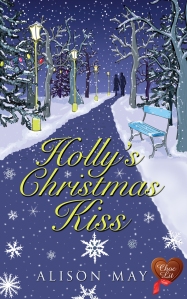
And finally… drumroll please… my second Christmas Kiss novella is nearly ready to be launched onto an unsuspecting world. Cora’s Christmas Kiss is going through its final tweaks and edits at the moment. We’re finalising the cover design, and it should be available to order very soon indeed. Squeeee! In the meantime I recommend that you all prepare yourselves fully by downloading book 1, Holly’s Christmas Kiss, forthwith.

Holly's Christmas Kiss

*takes a deep breath* So there you go. That’s all my publication news at the moment. And with that I shall stop thinking about books that are already written and turn my attention back to the books that are yet to come.

In which I randomly assert that writers are not special

I have two jobs. I have one job where I sit just exactly here on my rapidly expanding bottom and type words into documents that I hope one day people will want to read. In my other job I try to help people learn stuff. Sometimes I help them learn how to understand the welfare benefits system. Sometimes I help them learn how to write books. In the past I’ve helped people learn good interview skills, presentations skills, employment law, IT skills and various other things besides. It’s never crossed my mind that there might be some careers that you can’t learn to do. But some people think that my first job – the bottom sitting one – is just such a thing.

Back in March, Hanif Kureishi termed creative writing courses a ‘waste of time’. This caused a heightened level of eyebrow raising because Kureishi is a professor teaching in various areas of writing at Kingston University. It’s always good to see a tutor who’s confident in the quality of their own work, isn’t it? Having said that, other writers agreed with Kureishi about the limitations of creative writing courses, and he wasn’t the first to express reservations. Ray Bradbury, for example, told the Paris Review that college was a ‘very bad place for writers.

It seems to me that there are two things going on here. Firstly, there’s an unjustified leap in logic between identifying a bad course or poor teacher, and concluding that something can’t be taught. I’ve never been to one of Professor Kureishi’s lectures or tutorials, but if you find that a high percentage of your students are failing to learn the thing you’re supposed to be teaching, you’ve got to wonder if the problem is you rather than them. Many of Bradbury’s criticisms centre on the problem of tutors teaching based on their own preferences and likes/dislikes – that’s not a sign that’s something’s unteachable. That’s just a crappy teacher. There are lousy courses out there in plumbing, maths, crocheting, engineering and Japanese – it doesn’t mean that any of those things can’t be taught and learnt either.

And that brings me to the second thing I suspect is going on here. Us writers do sometimes have a slightly unattractive tendency to think that we’re special. Again, that’s not something that’s exclusive to writers – we all like to think that we are special unique snowflakes sometimes, but I think that sometimes as writers we tell ourselves that what we do is somehow different from other jobs. And in some ways it is – there’s a lot more pajama wearing than the average, for example. But we’re part of a whole raft of creative careers – from writing to fine art to theatre to engineering to graphic design etc. Any job that involves a moment where somebody says ‘What if we do…’ and the next thing that comes out of their mouth is an idea that wasn’t there before is creative. Creativity is brilliant, and precious, and, if you take a minute to look, absolutely bleeding everywhere.

I share my living quarters with EngineerBoy, and people often assume that we must have little or nothing in common in terms of how we work and how our brains work. But actually we talk about work all the time.* Designing engineering solutions and writing a book have a lot in common. Both start with an idea of what you’re trying to get to. Both suffer from the fact that that idea will, inevitably, change part way through the process. Both work best when you keep things simple. Both are marked by a bit about a third of the way in where you’re absolutely 100% certain that what you’re working on is a massive pile of poo that will never work. And then another bit like that about two thirds of the way through. And then another one just around the time you have to hit send and deliver the thing to your customer/publisher.

Writing a lesson plan is another act of creativity with lots in common with writing a story. A good lesson has a beginning, a middle and an end. It has a point that you hope the student will take away, and is has a great unknown quality that is beyond your control – for a lesson, that’s the student; for a story, it’s the reader. Both are going to take whatever you offer and respond to it, hopefully in the ways that you anticipated, sometimes in a completely different way, and sometimes, if you’re really lucky, in a way that makes the whole thing better, and richer and more successful than you ever thought.

Lots of jobs are like writing – some in small ways, some in much bigger ones, and generally we have very little problem with the notion that you can learn to do all those other jobs, but somehow we want writing to be innate. It’s not innate – at least not beyond the level at which human beings have a shared instinct to communicate and storytell. It’s something you can develop and improve. You can learn to be more creative, and you can learn to channel that creativity in specific ways. You can learn the skills of plotting and characterisation and editing and point of view.

And yes, part of the reason I’m saying this is because I’m a creative writing tutor and I have an upcoming workshop (spaces still available – click the link for details, go on, you know you want to) to promote. But it’s more than that. Telling people that certain skills can’t be taught is an example of people who’ve already achieved success adopting a mindset that keeps those who are still trying firmly in their place. It’s about saying ‘Well, I made it without any help. Why can’t you?’ And that’s just a bit of a miserable, divisive way of being. So bah humbug to that. Jolly good.

* Sounds dull, I know, but look. We’ve been married a really really long time. Any conversation beyond ‘What’s for tea?’ is frankly a marvel to be cherished at this stage.

In which I weigh into the whole Amazon vs Hachette ebook pricing argument

Day three of the Awesome Week of Daily Blogging and the posts are still coming thick and fast.* Today I thought I’d weigh into the whole Amazon vs Hachette debacle, because for a new author currently exclusively ebook published on Amazon there’s no way that could be unwise. (‘You have books on Amazon?’ I hear you ask. ‘Why Alison, you hardly mention that at all!’ Indeed. I am too modest. They’re here. Feel free to go buy them.)

For those of you who don’t spend your free time reading articles about corporate disputes in the publishing industry, essentially Amazon (who I’m guessing you’ve heard of) and Hachette (who are a big publisher) have fallen out over new contract negotiations over ebook pricing. Amazon think ebooks should be cheaper. Hachette don’t agree, or, perhaps, just don’t want that to be up to Amazon. I’m simplifying, obviously, and if you’re really interested in the finer details you know where google is, and, if that’s too much effort, there’s some interesting stuff about the changes in the ebook pricing model that led up to this point here.

What I am going to bang on about is the way in which this whole hullabaloo** has led to an outbreak of rather bizarre open letter writing. 900 authors have signed this letter ‘to their readers,’ but actually clearly aimed at Amazon, and helpfully popped the whole thing in the New York Times. Amazon have written this letter to their kindle authors, but actually clearly aimed at Hachette, and, even more helpfully, popped it on the interweb for the world to see too (horribly misrepresented Orwell quote and all). Now part of me applauds this approach to doing business. It might have been thought that letter writing was a dying art, but apparently not. What does seem to be a dying art is the ability to address one’s letter to the relevant person and pop it in an envelope. Open letters are suddenly very much in vogue.

It’s not limited to publishing industry pricing disputes. Gyrate around on TV wearing a flesh coloured leotard accessorized with 2013’s Robin Thicke and people start writing them. Suggest that people ought not to vote, and people write them. And frankly I’m a bit annoyed. Irrationally annoyed, I admit, but annoyed nonetheless. If you want to say something to one individual or company, write them a letter. If you want to say something to a more general audience, write an article or a book or a blogpost or an exceptionally pithy tweet. If the thing you want to say is primarily aimed at improving your own commercial position then be honest with the universe and write an advert.

I’m not quite sure what it is about open letters that winds me up so. Actually, yes, I am sure. It’s the double standard. Open letter writers are trying to have it both ways. When you write something publicly you run the risk that people will think it’s dull, or crap, or will just disagree vehemently with the thought you’ve spent hours crafting and trying to communicate. When you call the thing you’ve written an open letter, you’re giving yourself a get out of being able to pretend it was only really aimed at the named recipient. But it’s not, is it? Because if it was you’d have got a stamp and an envelope and just sent it to them. But maybe you can’t. Maybe the person in question hasn’t given you their address, or email, but that couldn’t possibly be because you don’t know them and they don’t care what you think, could it? Obviously they, and everyone else, need to know what you think. Which is fine. I’m in no position to criticise anyone for the random spouting of opinion at the world. But stop pretending that it’s personal, when it’s just some stuff you reckon.

Now that’s probably a tad unfair on the authors who wrote to their readers, and the wider world, about Amazon. They do clearly have a vested interest in the dispute between Amazon and Hachette and in the wider direction of travel of ebook pricing and the bigger question of who now controls the publishing industry. But there’s another element that I find difficult here, which is that it’s starting to feel as though authors are expected to pick a side. I’ve been asked on facebook and other forums for a view and it’s tricky. The bottom line is that Amazon are a big ol’ business. They’ve already killed off a huge section of the physical bookselling market. They’re moving aggressively into publishing. From a commercial point of view, I see no reason why they wouldn’t want to dominate on both the publishing and retail sides of the business, which sounds bad, but they’ve also brought opportunities for new authors (me included) through the ebook market and the explosion in self-publishing which Amazon has massively supported. Big publishers are increasingly risk averse – previously secure mid-list authors have seen their contracts cancelled or not renewed in recent years, pushing many of them, slightly ironically, into Amazon’s self-publishing embrace.

For the individual players in the system – readers and authors – any one company, or cohort of companies, having dominance is probably not ideal, but being asked whether you’d prefer your industry to be dominated by one retailer or by a few big publishers is no real choice at all. What I want, as an individual author, is to get good quality books out to readers, and to be able to make a living from doing that. However the current round of chips falls, it feels like it’s getting harder and harder to do that.

And everyone breathe. Thank-you.

* Once per day. At best.

** It’s definitely the correct technical term. Stick with me.

In which I muse on what I learnt at the RNA Conference 2014

There was no post on Friday last week because I was off on my annual trip out into the world of ‘Real People who do talking and that’ at the Romantic Novelists’ Association Conference. As ever, conference was rather marvelous and I learnt many things. As is becoming traditional, I shall relay just some of those things to you by way of a numbered list.

1. Juxtaposing one’s thingy is important in more ways than you might think.

Now I’m presuming that you probably didn’t think juxtaposing your thingy was important at all, but that was the ‘take home’ message from Jane Lovering and Rhoda Baxter‘s talk on writing comedy. Juxtaposition is important in the serious business of being funny. A person giving a lecture isn’t a funny idea. A person wearing a penguin onesie is only a slightly funny idea. A person giving a lecture wearing a penguin onesie has comic potential. That’s juxtaposition that is.

Juxtaposition also came up in Clare Mackintosh‘s talk on creating a writing persona. Clare talked about writing things like the About Me section of an author website, and bios for inside books and on guest blog posts and the like. She also talked more generally about writing copy to promote yourself, and the need to provide an interesting hook for reporters to grab hold of. ‘Writer writes book’ isn’t news. ‘Retired burlesque dancer writes book’ might be. Juxtaposition again. It’s all over the shop, I tell you.


2. Sometimes it’s important to sit down and have a little plan

The one and only downside of the RNA Conference is that I come home every year with new ideas and new possibilities for what to work on next and what to do to try to move my writing career forward. This year emphasised how tough things are in the publishing industry at the moment. There are lots of opportunities, and smaller publishers, like Choc Lit, are really well placed to respond quickly to the way the market is changing, but, at the moment, incomes for writers are in decline. It’s not enough to write one really good book per year – if you want to make the bulk of your living from writing you need a plan and possibly a spreadsheet.

That means that right now I’m in a quandary where I have at least 4 different ideas for what my next book could be, and a couple of other interesting possibilities that came up in conversations with other writers during the conference. I need to take a minute to think What’s the best option? What moves me forward to a wider readership? Alongside the basic question of What am I really passionate about writing?


3. I have a gift for breaking dresses at crucial moments

At my first RNA Conference in 2011, I snapped the strap on my party dress while I was sitting in the bar before the big Gala Dinner. That meant I got to bond very quickly with the delightful Talli Roland who I hadn’t really met before, while she ran running repairs on my straps while I held my frock up to cover my boobs until she’d finished.

This year I pulled the crucial button off my wrap dress while I was getting ready and, despite best attempts to fix it with safety pins, ended up wearing jeans to the Gala night, which wasn’t very partyish, but did mean I got away with flat shoes that I could walk in, which was rather lovely.

Flat shoes!


4. Location, Location, Location isn’t just a TV show

My favourite session of the weekend was Janet Gover‘s talk on Location. I tend to think of a novel as a triumverate of three things – Character, Plot and Setting, andthe weakest of the three in my novelisting armoury is definitely Setting. My editor does, on occasion, have to ask things like ‘Where does this scene happen?’ Oops. So this talk was a must-see for me. And it was well worth dragging myself out of bed for the 9am start on Sunday morning. I came away with lots of ideas about how to strengthen the setting in my current novella-in-progress, particularly in terms of how the place that characters grow up and live might impact on the sort of people that they are.


5. And finally, it’s always worth balling up your confidence and talking to agenty, editory type people

The RNA Conference always offers the opportunity to do one-to-ones with agents and editors to get your writing in front of people who might be able to shepherd it out into the world. I don’t normally bother, because I’m awful at the whole elevator pitch thing. It’s really only in the last year that I’ve got my head around even being able to talk coherently about what I write, so talking about it to agents and editors is a bit scary.

This year I found myself in the position of having a project on the back burner that I’d been ignoring because I know it’s not suitable for my publisher, Choc Lit, who are a romance specialist. This is a more literary project with elements of family drama and crime, but when I looked at the conference schedule I saw that Lisa Eveleigh from Richford Becklow was offering one-to-ones, so I took a deep breathe and sent off my synopsis, and then took myself along to meet with her. And very lovely she was too. She offered a couple of really useful plot suggestions, seemed to have really understood what I was trying to do with the story, and said she’d be happy to take a look at the full manuscript once I’m at that stage. Which takes us all the way back to number 2 – time to sit down, take a minute and make a little plan of what to do next…


My current novel, Sweet Nothing, and novella, Holly’s Christmas Kiss,  are available now for kindle.

In which a year has passed and I muse on how it takes a village and all that guff

So this time next week I shall be in Telford getting ready for my fourth RNA Conference. That realisation made me also realise that it is now 1 whole year since I signed my first ever publishing contract with Choc Lit to publish Sweet Nothing, followed later in the year with a second contact for Holly’s Christmas Kiss.

Sweet Nothing

Holly's Christmas Kiss

One year on from such great excitement seems like as good a time as any to get a bit melancholy, raise a glass of something suspiciously green-looking, and have a bit of a think about the process of getting from ‘Hey guys, I’m going to write a novel!’ to actually having a novel out there in the world, where unsuspecting strangers, some of whom aren’t even friends of your mum, might read it.

And the conclusion of that little think would be this: it takes a village to make a novel. Not an actual village. It’s not compulsory for budding novelists to move to Little Middlewitch and start helping out with the church flowers. I’m talking about one of those metaphorical villages that exist only for the purposes of slightly laboured and clichéd metaphor. The Sweet Nothing Metaphorical Village takes in many helpful souls. There are the tutors and workshop leaders whose ideas I’ve cribbed and developed. There are the critique readers. There are the supportive wine-supplying friends who tolerate the fact that most of my gossip is about made up people. There’s the actual publisher who decided to invest their time and money in my work, and then there’s the editor, copy-editor, proofreader, cover designer and blurb writer. And then once the book is out there’s the audiobook people, and the pr dudes, and the book reviewers and bloggers who’ve featured me or my books on their site.

So it’s one whole year since I signed the contract with Choc Lit to publish Sweet Nothing. It’s six years since I first decided I wanted to write a romantic comedy, and decided that I wanted to base it on what I consider to be the ultimate rom-com from stage, book or screen. And the end result is a story that owes everything to my random set of pre-occupations: love and how it’s not the same as romance, how clever people can do stupid things, how knowing stuff is brilliant, tequila is dangerous, and M&S party food is the highest form of food. All of that stuff is part of me, but none of it would be out there in a vaguely readable form without the rest of the Sweet Nothing Metaphorical Village.

So please all raise your glasses. Wait. I didn’t mention that you needed glasses, did I? Ok. Those of you who are already glass-ready, give everyone else a second to pour themselves a tiny drinkette. Right, so please raise your glasses and let’s make a toast, to everyone in the Sweet Nothing Metaphorical Village. Cheers, and thank-you all.