Blog

In which I wonder whether it’s even worth having an opinion

There are some truths which, in this little hippy liberal corner of the interweb at least, we hold to be self-evident. Things like the idea that extreme weather events definitely aren’t caused by Katy Perry kissing a girl and liking it, and that the welfare state is, on balance, A Good Thing. Other Good Things would include the NHS, the BBC, free movement of people across borders and the recognition that newspaper headlines that are phrased as a yes/no question can almost always be answered, ‘Probably not.’ (EG ‘Is your iPod giving you cancer?’ ‘Are floods of immigrants going to establish sharia law in Melton Mowbray?’ etc. I made those two up, but you get the idea.)

What is depressing this little corner of the interweb today, is the unfortunately equally self-evident fact, that none of these opinions matter. My opinions, like most of yours, are irrelevant to my political overlords. I’m not rich enough to be likely to donate significant money to any political party. I’m not a hard-working family, being childless and generally quite lazy, and therefore, it would appear that very few politicians see me as a demographic worth pursuing.

Having said that I do live in a relatively marginal parliamentary seat with a current majority of less than 3000. Marginal seats are the places that actually matter in general elections – the seats where the sitting MP has a small lead and where the seat could plausibly change hands. That should mean that I’m one of the people who politicians are spending stupid amounts of money trying to please. So why aren’t the papers full of stories about politicians competitively trying to outdo one another over how lax they want to make our border controls, and aggressively trying to give passing unemployed people free monkeys and tv licences, and maybe a nationalised railway to play with? All of that would appeal immensely to me, but none of it is happening.

And it’s not happening, because although I live in a relatively marginal parliamentary seat, I’m not an undecided or swing voter. The problem is that I know what I think, so when my hereditary Tory MP turns up on the doorstep, our views are already too diametrically opposed for there to be any significant risk of me voting for him, so, although I might berate him lightly for a while, neither of our hearts are really in it, and in the end we just shrug at one another and he pops off to try to woo someone more plausibly wooable. Essentially the people whose opinions matter to politicians are the group of people who:

a) live in marginal constituencies;

b) are undecided about how to vote (and ideally are undecided between the 1st and 2nd place parties – people umming and aahing between the Greens and a friendly looking Independent are less relevant); and

c) are definitely intending to vote for someone.

In the 100 most marginal seats in Britain at the moment (based on 2010 electoral boundaries and results), the total number of votes between the 1st and 2nd place parties is just over 120000. If we keep things simple (simpler admittedly than they actually are) and just think about votes shifting from the 1st place to the 2nd place party, you only need half (plus one) of those voters to move to change the result. So that’s 60000ish voters whose intentions politicians are actually interested in. The current population of Britain is roughly 64 million, and the number eligible to vote in general elections is around 46 million. That means, in practical terms, somewhere around 0.1% of the electorate actually have the electoral clout to influence political debate and policy. Obviously that maths is massively dodgy and oversimplified but the conclusion pretty much holds. A very small section of the population actually cast votes that make a difference to the outcome of major elections, and I’m not one of them, and if you’re not one of them there is very little incentive for career politicians to care what you think. And I find that rather depressing. That is all.
In which I am drawn into a blog chain

Last week Sally Jenkins invited me to join a writerly little blog chain. Sally is a writer who specialises in shorter length fiction and the odd article. Two of her story collections have been published on Kindle and she is currently kicking her 2013 NaNoWriMo script into shape. She’s also a member of the Romantic Novelists’ Association Birmingham Chapter (yes, we call our local groups ‘chapters’ – do you see what we did there?) and is thoroughly charming, so who was I to say no?

There are four writery questions I’m supposed to answer, and I shall do so forthwith:

1. What am I working on?

At the moment I’m working on my second full length novel, which will, with luck and a bit more writing the book and a bit less skiving off to write blogposts, be published by Choc Lit sometime in early-mid 2015. Following on from Much Ado About Sweet Nothing (which, just for your information and not implying you should all go and buy it immediately at all, is in the January kindle 100 deal and is, therefore, 99 tiny pennies at the moment) I wanted to write another Shakespeare adaptation. I love writing adaptations – I like the slightly analytical/puzzley element of working out how to take a story apart and rebuild it again in a different form. This time I’m having a go at A Midsummer Night’s Dream. It’s an amazing play – all the action takes place within 24 hours, and there are feuding fairies, and star-crossed lovers, and a guy who gets turned into a donkey. All of which makes it a prime candidate to be reset in a low-grade, early twenty-first century, midlands university. I hope.

And then after that I’ll be straight into writing the sequel to Holly’s Christmas Kiss, which should be ready to come out as an e-novella this Christmas.

2. How does my work differ from others of its genre?

Well there’s the Shakespeare thing for starters. But what I try to do more than anything else is write about love, rather than romance. Weirdly, perhaps, for a romance writer, I don’t really trust romance. Sweet words, and big gestures are easy. Love though, can be really hard. Real people are annoying and react unpredictably and do stupid stuff and hurt people they care about and then quite often make it worse while they’re trying to fix it. I’m much much more interested in all of that than I am in eyes meeting across crowded rooms. Having said that, my Christmas stories do tend to be a bit more traditionally romantic – well, you know it’s Christmas!

3. Why do I write what I do?

I write stuff that I would want to read. So far I’ve mainly been writing romantic comedy, but I wouldn’t rule out a switch of genre in the future. I love to read chick lit, sci-fi, more literary stuff, occasional historicals and I’m even starting to get into odd bits and bobs of crime, and I think lots of readers are the same. So never say never to writing something completely different – I have a back-burner project which is a more literary timeslip story that I definitely intend to get back to one day. At the moment though I’m signed with a romance and women’s fiction publisher (the utterly fab Choc Lit) and I’m really happy writing in that genre for the forseeable future at least.

4. How does my writing process work?

Procrastinate a lot. Write a little. Procrastinate a lot more. Write a tiny bit. Realise I need to get whatever I’m working on finished by about two weeks ago at the latest. Panic. Write a lot. Panic a bit more. Cry. Reread what I’ve written. Have huge crisis of confidence which I’m convinced is a completely different to all the crises I’ve had previously. Reread again. Edit. Submit to publisher with long apologetic email about how crap the manuscript is. Click refresh on email obsessively until publisher replies saying she’s sure it’ll be fine. Promise self I’ll definitely make a start on the next book while I’m waiting for the edits and revisions to come through. Procrastinate some more. Get revisions from editor. Deal with those straight away (I’m one of those freaky writers who prefers editing to writing – weird I know). Deal with copy edits and proof reading queries, again with only mild procrastination at this point. Realise that there is now absolutely no excuse not to start on next book. Procrastinate a bit more. Repeat process from beginning.

I’m not saying it’s efficient, but that is a pretty accurate description of my ‘artistic process.’ Oh dear.

So that’s me as a writer in 4 easy questions. And as this is a blog chain I’m supposed to have identified 3 more writers to carry it on. Er… oopsy?

So all that remains is to remind you  again (with huge apologies for the promoyness) that Much Ado About Sweet Nothing is just 99p during January (or $1.63 for Americans). Trust me – it is really rather jolly, and has a slime mould and a big white wedding. Something for everyone there, I’d say.

MAASN_small final cover

In which I undertake the traditional resolution making for the year ahead

Hello. Good morning and ahoy there my hearties. Welcome to 2014. I trust you have found it to be conducive to good cheer and ever so lightly flavoured with cinnamon so far, apart from the thing about it being flavoured with cinnamon. It’s a year. Years don’t really taste of anything, with the exception of 1994, which I think we can all agree was a more than a little bit minty.

Anyhow, given that that whole train of thought had somewhat got away from me, I’ve made the executive decision to start a brand new flavour-free paragraph so that we can all just move on. It is, as I believe I may have been wending my rather circuitous way towards saying, a whole new year, and traditionally at this point in the calendar I make a number of resolutions. Broadly speaking they are threefold:

1. Lose weight

2. Get over the driving phobia

3. Write more/better/more profitably/preferably all of the above.

And all three of those resolutions definitely apply this year, on account of how I totally failed to achieve 1. and 2. last year, and although there were some definite writing achievements in 2013, there is always further room for improvement. That means that my resolution making is a rather quick and speedy process. I’m pretty confident that I’ve got those resolutions locked down to come around every year for at least the next decade, which is marvellous because it frees up time and head space to get on with doing and achieving random things that you’d never think to aim for at the start of the year.

Last year, for example, although I had definite good intentions in the area of writing, I hadn’t thought of ‘Become the Cliff Richard of the kindle novella market’ as a specific aim, but I still managed to tick it off, when my little Christmas romance novella, Holly’s Christmas Kiss, went to no 1 in the Kindle short story chart and stayed there until Christmas Day. I had an actual Christmas Number 1. I shall now mainly be hanging out with the previously mentioned Sir Cliff of Richard, Noddy Holder, and that prison guard lady off of X-Factor.

Having your basic resolutions nailed down also gives you plenty of spare brain-time to really finesse your plans and systems for how those resolutions might be achieved. So far as the losing weight goes, I have constructed the most marvellously convoluted diet plan which involves dieting for 6 months in 3 week bursts over a 2 year period. And the worrying thing is that I totally have a rationale for why that is a good idea, based on actual science (or at least on things I have heard actual scientists say on telly, which I suspect might not be quite the same thing, but still, a plan is a plan so I’m sticking with it).

I also have a plan for the writing stuff to be done this year. It involves finishing one and a half novels and a novella, and getting back into teaching creative writing and offering workshops, and possibly a critiquing service for new writers. It’s almost certainly completely unrealistic, but I have a spreadsheet with all the different things I’m going to do marked on it and highlighted in a range of pretty colours, and making the spreadsheet was useful and not really procrastination at all.

So that just leaves the driving phobia, which is the only one where I don’t have a plan, beyond ‘try to sit in the driver’s seat without crying.’ Oh well, there’s always next year.

So, as I always ask you at this time of year, what are your resolutions? (And also, any of you who are budding writers please feel free to wave a hand via the Contact Me page if you’d be interested in workshops or courses at all.)

In which I run around covered in tinsel singing Christmas carols at full volume

It’s Christmas.

Nearly.

It’s certainly Christmas enough to start decking your halls, resting your merry gentlemen and generally stockpiling alcohol like there’s an unprecedented sherry shortage about to hit.

I love Christmas. Some people don’t. Some people say things like, ‘Well it’s just for the kids really,’ and complain about things like the appropriation of Christian tradition for commercial purposes, or the appropriation of ancient pagan tradition for Christian purposes. Some of those people may have a point, but they’re still fundamentally wrong-headed. Christmas is not the time for rational argument and making a valid point. Christmas is the time for Noddy Holder, and playing parlour games the precise origins of which are lost in the mists of time but will inevitably lead to an argument with your grandmother about whether The Gingerbreads were a real pop band.

Christmas is also the time for reading, and writing, a particular type of story. Writers have been inspired by Christmas for generations. Ever since Luke sat down and penned that dynamite passage about a census, back in the days when Quirinius was Governor of Syria, writers have been writing about all things Christmas.

Dickens did it. Richard Curtis did it. Greg Rossen and Bryan Sawyer did it.* And lots of other very clever writers did it too. So in honour of Christmas and not wanting to look so terribly un-English as to just bang on about my own book, I asked some of them about their Christmas stories and what inspired them.

Kate Johnson has published two Christmas novellas, Elf Gratification (published as Cat Marsters), an erotic novella featuring gratification, and one assumes, elves, and a festive prequel to her Sophie Green series. Talking about the Sophie Green book, The Twelve Lies of Christmas, Kate said, ‘I sat and thought about what was great about Christmas: the good cheer, strangers wishing each other Happy Christmas, the special food and drink, time spent with friends and family, the presents, the bobble hats,  the decorations…the break from normal life. But what if you don’t have any of those things? Except for maybe the bobble hats?’

Jo Beverley has released, not one, not two, but three Christmas novellas. She told me that she loves ‘writing books set around Christmas because the celebrations often involve opening homes to company, which can bring people together who might not otherwise meet or reencounter,’ and added that, ‘the emotions around Christmas can also be stressful, which creates tension and conflict.’

Chrissie Loveday‘s Christmas novella, A Computer Guy for Christmas, is due out this week. She commented, ‘I adore Christmas! Our house is awash with lights, trees and all things Christmassy. Of course I wanted to write about it! What a perfect excuse to share it all.’ The story features an office party, and looks at the tension between spending Christmas with family and maintaining a budding romance.

So Christmas gives writers the chance to bring characters together, and throw a bit of stress into the mix, but also to sprinkle a little bit of fairy dust (and a lot of fairy lights) over their story, and incorporate as many bobble hats as they like. And this year… (SOUND THE KLAXON – BLATANT SELF PROMOTION ALERT) I joined in, with my festive romance, Holly’s Christmas Kiss.

Holly's Christmas Kiss cover

Holly’s Christmas Kiss is a much sweeter, in some ways much more innocent, story that I normally write, but I adored writing it. I love the fact that at Christmas you can take off the good taste brakes and throw every single Christmas image you can think of into the mix. So there’s mistletoe and Christmas trees and and a turkey and Santa and presents and… well it’s pretty darn Christmassy. Anyway, you could read it if you wanted, or not. Merry Christmas one and all either way.

Right. Well now I’d best be off to baste my merry gentleman and try not to dismay my turkey. Toodle-pip.

* What do you mean ‘who are Greg Rossen and Bryan Sawyer?’? Why, only the creative geniuses (geniuii?) behind David Hasselhoff’s 2012 Christmas extravaganza The Christmas Consultant. Tsk at you for not knowing.

In which I have a book out and undertake the pondering of various things

Ahoy.  Good afternoon and howdy there. I have been remiss of late in the tending of this little bloggy corner of the internet. I’ve been gadding all over the shop writing blogs for other people left (What make’s a hero? for Choc Lit), right (Letters to my younger self for Serendipity Reviews), and centre (Adapting Shakespeare for The Romaniacs), and my first novel has come out.

Waaaaah!

Yes. Indeedy. It is true. Much Ado About Sweet Nothing is now out there in the world and is all buyable for your kindle (or your kindle smartphone/tablet/PC app). So you could buy it if you wanted. I’d be delighted if you did.

All of which explains why my head is a bit all over the place, but does not excuse the lack of good blog maintenance. Now I’m back at it, I can see that there are cobwebs in the corner, and the occasional table needs its doilies freshening. Yes. My blog has doilies and an occasional table. Please feel free to make up your own jokes about what the table is the rest of the time.

So in order to get up to date on the blog I’ve done a whistle stop tour of the internet to identify the main concerns of the day, generated some arbitrary opinions on them and arranged the whole thing into a numbered list. Here we go:


1. Tom Daley is dating a guy. I have two opinions on this. Opinion 1: Lucky guy. Opinion 2: This shouldn’t be news. I’m slightly sad that it so clearly still is. Tom Daley is famous for being unusually good at jumping prettily into water. That would seem to be an activity that can be achieved equally competently whether the jumper in question is gay, straight, bisexual, asexual or entirely undecided. So it’s nice that he seems happy. If there are kids who are questioning their own sexuality who gain strength or a sense of solidarity from his announcement that’s brilliant, but really really sad that it’s considered Big News.


2. Men and women’s brains are wired differently. No. No. They’re not. Firstly nobody’s brain is wired. I know this. It’s why as a freelancer who goes into lots of different organisations I am required to have professional indemnity insurance, but have never had to have my head PAT tested. The study the headline is based on is here. Just from the abstract you can see that the study only looked at people up to age 22. The study also noted that differences are greatest during puberty but reduce during adulthood. So interesting stuff medically for anyone studying neurological conditions that are more common in one gender than the other, but not a reason to sack your female CEO and hire a man or vice versa.


3. The University of Kent were tad rude about children’s and genre fiction. Clearly what we have here is what used to be known as a storm in a teacup, and is now just known as Twitter. Having said that, university level courses in creative writing have expanded massively over the last few years, and if you’re serious enough about writing to do a BA or MA then you do need to think about choosing your course carefully. I did the sort of broad covers-a-bit-of-everything course that Kent so obviously don’t offer, and it was brilliant for me. I started off thinking I was a playwright, and left as a rom com prose writer. If I’d done a narrow playwrighting MA I would never have known.


4. Michael Gove still doesn’t understand how education works.


I think that’s all. Presumably some real news has also happened while I’ve been distracted, but you know better than to look for coherent thoughts about serious things here. Ta-ra for now.

In which I have an actual book cover for the actual (virtual) book what I wrote

Ta dah!

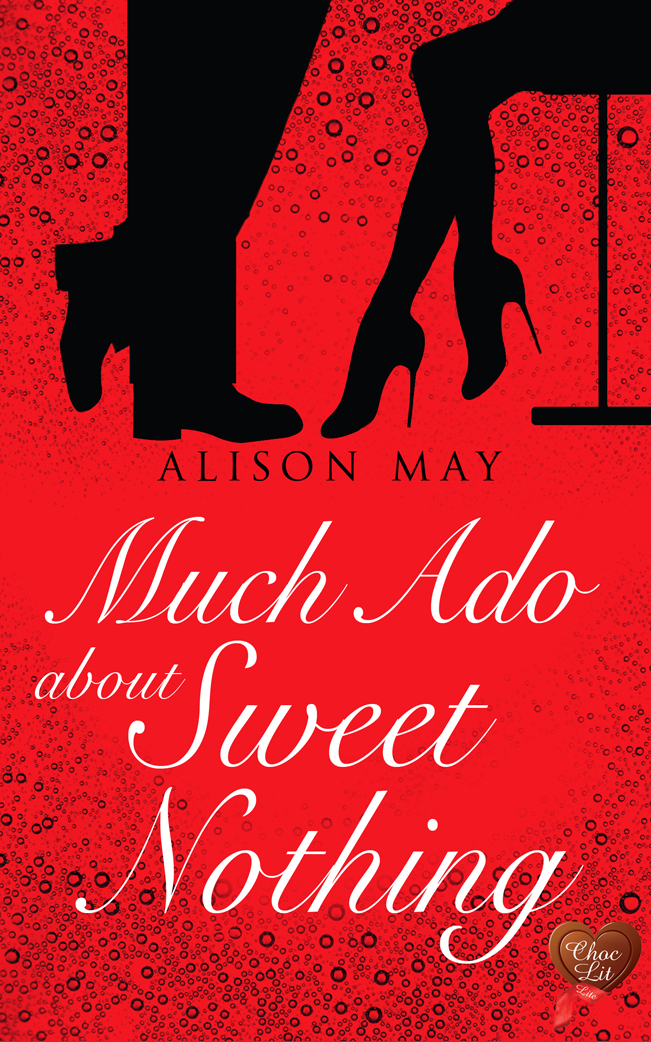
So there is it. The cover for my first novel. The astute amongst you will also notice that it has a new title. The book formerly known as ‘Well it’s the book  I wrote; it’s sort of about love and maths and stuff and it’s based on a play,’ is now officially titled, Much Ado About Sweet Nothing. Weirdly, my publisher felt that worked better. Curious.

Anyway, there it is. My first book cover. Huzzah!

(BTW, if you want a bit more of me wittering about romance writing related stuff, I’m on the Choc Lit authors’ blog today talking about What makes a hero: http://blog.choc-lit.co.uk/?p=5145)

In which I go on a writing retreat and it is all rather lovely

I got home last night from a two night writing retreat in deepest Devon. I’m rather proud of that sentence. While my publisher was busily winning Publisher of the Year, at the 2013 Festival of Romance (just had to get that in – yay Choc Lit!), I was on a retreat. Going on a ‘writing retreat’ really does sound like something that other, better, more grown-up writers would do. Proper writers with lots of writerly jewellery and a penchant for scarves and overusing the word ‘Darling,’ darling.

However, somehow I managed to slip under the radar and got allowed into to Retreats For You, on a tutored retreat with most excellent writer and Queen of the writing tutors, Julie Cohen. Retreats For You is an utterly brilliant place, run by Deborah Dooley and her partner, Bob. It provides a perfect little bubble in which to just do writing, with no distractions beyond the possibility of going out for a little stomp around the Devon countryside or wandering into the kitchen and snaffling another piece of flapjack. So my weekend was all open fires and literary thoughts…lounge-150x150

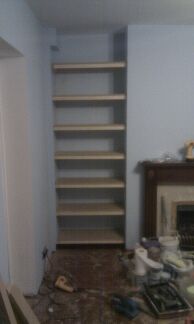
while, Engineer Boy stayed home and built these:

Now I need to buy more books

Apparently, these are just to store the insane number of books, I already own, rather than an excuse to buy tonnes more. We shall see…

Anyway, back to the retreat – Julie provided a counterpoint to all the lovely, comforting, warmth that Deborah offers, with her usual tough love approach to writing critique. Julie is not the right writing tutor for you, if you want to be patted on the head and told that everything you’ve written is brilliant. If you want to make the sodding book actually work and get written, she’s bloody marvellous though.

I’m in the early stages (about 25k in) of novel 2 at the moment, with novel 1 scheduled to launch into the world in the next few weeks. And I won’t lie. I’ve been struggling. Writing your second novel is an odd process. You know so much more than you did when you started novel 1, but that additional knowledge can be paralysing. It means that you see all of the problems as you’re writing them, so, rather than just bashing out a shoddy first draft which you can revise later, you get caught up trying to fix the problems as you go along and end up not really progressing at all.

Sometimes what you need at that point is a fresh pair of eyes to look at you sternly, and remind you to keep it simple and try not to actively turn your protagonist into an entirely unsympathetic psychopath. With novel 1, I can pinpoint the moment when it shifted from being an idea, into being a potential book. It was a conversation in a tutorial with my university tutor, Deb Catesby, where we talked about characterisation ideas. It sounds like a very minor point, but that was the point at which I decided that Ben, the hero, would be a mathematician. That decision defines how Ben sees the world, which defines how he interacts with the heroine, Trix, and how she then responds to him. It also gives the book it’s theme: Nothing & Everything (or for the maths-minded amongst you Zero & Infinity).

I think (although it’s too soon to be sure) that I had the equivalent of that conversation this weekend. Julie helped me to work out what my protagonist’s fundamental character needs are. Before that conversation I knew what the plot required her to do, but I hadn’t got clear why she behaves in the way that she does. Without that why, it’s almost impossible to give her the emotional depth she needs to make the reader empathise with her situation and behaviour.

Writing is a generally very solitary endeavour. That is part of the reason that we value organisations like the Romantic Novelists’ Association, that give us chances to change out of our pyjamas and interact with real people, so highly. It’s also part of the reason that we get so addicted to twitter and facebook. It makes a nice change from only talking with made up people. Sometimes though, you need to step away from your laptop and find a fresh brain to bounce ideas off, and you need that to be a person who’ll tell you honestly if they think you’re going the wrong way.

So, in summary, hurrah for Deborah Dooley and Retreats For You. Hurrah for really good writing tutors – Julie and Deb. And now, hurrah for getting one’s head down, stopping procrastinating, and just writing the bloody book.

In which I weigh into the debate on qualified and unqualified teachers

The coalition have had a little falling out recently over education, specifically over the rules regarding unqualified teachers. Currently free schools and academies are permitted to appoint teachers who don’t hold qualified teacher status, and in September 2012 the rules on teacher qualification for all state maintained schools were slightly relaxed. As yet, it’s not clear how big an effect this most recent change has had, but there’s some more information on numbers of unqualified teachers in free schools here.

I’ll pin my colours to the mast upfront, and say that I am a qualified teacher. I’ve never taught in school, and specialise in teaching adults in the workplace and community. However, I still have a bit of a bee in my bonnet over the perceived professionalism of teaching.

The idea of allowing, or encouraging, schools to appoint individuals without a teaching qualification seems to be an attempt to get more inspirational individuals from different professional backgrounds into schools. On face value, that’s laudable. A big part of education is about engaging and inspiring students, and having direct contact with people who’ve achieved success in different professions is one good way of doing that. It’s also a way of bringing up to date expertise into the classroom, and it’s perfectly possible that some of those individuals will be charismatic classroom teachers. Others won’t – in-depth knowledge and the ability to communicate that knowledge are not necessarily overlapping skills.

However, subject expertise and charisma aren’t the be all and end all of good teaching. You need to be able to do behaviour management, lesson planning, formative assessment, summative assessment, designing learning outcomes, designing learning activities and resources, differentiating within your lesson for different abilities and learning speeds, adapting your lesson plan to the realities of the class in front of you – and all of those things are skills that need to be thought about and developed.

That doesn’t mean that someone who joins a school without a teaching qualification can’t learn those skills, but I do think it demonstrates that teaching qualifications have value. It also suggests to me that politicians in the department of education don’t really understand the complexity of a teacher’s role. It appears that they equate good teaching with simply knowing about your subject and being able to talk about it. Both those things are important, but they’re not everything. A teaching qualification demonstrates that you’ve spent time gaining an understanding of the theories and practice that underpin good teaching and effective learning.

Michael Gove (oh come on – you knew I’d get to him eventually, didn’t you?) has been vocal about GCSE and A’Level ‘grade inflation,’ and spoke last week, defending his preference for more rigorous testing of children. He said:

“Imagine that you had a choice not of schools, but of airlines. There is Test Airlines, very rigorous, and there is Warm and Fuzzy Airlines. What’s the difference between the two? In Test Airlines they actually insist that the pilots have passed a test so that they can fly a plane. How old-fashioned can you get?

“At Warm and Fuzzy Airlines, they don’t bother with these tests to see if pilots can fly. They just concentrate on all of the pilots giving the customers a warm and fuzzy feeling as soon as they get on board. Which would you fly with?”

Well yes. Quite. What I simply don’t understand is why you would apply that logic in one case and decide that tougher qualifications are good for children, but, at the same time, conclude that formal qualifications in teaching aren’t necessary for their teachers? Either qualifications matter and tell us something about a person’s skills and expertise, or they don’t. The bottom line here, I suspect, is that Gove simply doesn’t see teaching as a complex, expert profession; he sees it as something that anyone who knows a bit about a subject can probably have a jolly good stab at. And conversely, that attitude is probably exactly the one that will discourage the most expert and highest achieving individuals in different fields from considering teaching as a career. Rather than opening up teaching, it lowers the status of the profession, and discourages both current and potential teachers. You wouldn’t want an unqualified doctor, dentist, pilot, solicitor, or electrician. So why would you value your child’s (or your own) education less highly than your fusebox?

In which I think about the difference between real-life and makey-uppy

‘Fiction makes sense and real life doesn’t.’ The very clever and lovely Julie Cohen has just announced that to me out of my computer (via Writers’ Web TV – she doesn’t actually live in my computer, I don’t think). And that thought set off a little ping inside my brain because I’ve been thinking about that very question of the distinction between real life and makey-uppy a lot of late.

I’m currently working with my delightful new editor on the final tweaks to Sweet Nothing, which, barring last minute delays, will be out in the world next month. And I’m starting to think seriously, for the first time, about the fact that people might read it. Realistically, as it’s a debut novel by a total unknown a high percentage of the people who read it will be friends or acquaintances. And at least some of those people are going to read my story of a bickery and weirdly dysfunctional relationship between a nerdy thirty-something year old man and an artsy-literary woman, and they’re are going to look at myself and EngineerBoy and they’re going to make a fairly obvious assumption about where the inspiration for those two characters came from.

And when they do that I will huff and puff, and get offended and bang on about how it’s obviously fiction and it’s not based on real life, and I shall probably say that it’s shows a lack of imagination to assume such a lack of imagination on the part of the writer. And when I react like that I shall be at least half right.

But actually it’s a little bit more complicated than that. Those two characters absolutely aren’t based on EngineerBoy and me. I can’t, personally, think of anything more skin crawling than consciously and intentionally typing out the details of your most intimate relationships and then sending them to a beta reader and an editor and then out into the world. I feel faintly exposed just typing the notion onto this blog. Developing and writing those characters, I didn’t start by thinking about any real people. They, and all the characters, are absolutely the product of my imagination.

However, my imagination is absolutely the product of my environment. What I imagine about how relationships work is entirely borne out of my own relationships. All the characters I write are products of my overcrowded, butterfly brain. It’s all completely made up, but I can only make-up what I can make up and that is bounded by the life I’ve lived and the people I know. So it’s kind of a circular problem. The characters I write and the stories I tell are definitely made up and definitely aren’t based on real life, but they’re made up out of my imagination, which is sculpted and defined by my real life, and round and round and round we go.

So, if you are so kind as to read Sweet Nothing when it comes out and you think you recognise a person or a place or an incident, don’t be scared – I promise that it isn’t you, or at least, if it is, I don’t know that it is, so there’s no need to feel weird. And here end my random writerly musings. I shall return soon, when hopefully Michael Gove will have annoyed me in a new and interesting way and I’ll be able to get a proper rant going. I’ve not had one of them for a while…


In which I wonder when showing one’s actual face became laudable

Now from that title you might be expecting me to weigh into the issue of Muslim women wearing a full face veil. Well, sorry if I disappoint but that ain’t going to happen around here.  Wear a veil if you want to; don’t if you don’t. I really have nothing more to say on the issue.

What I do have something to say about is this – the Children in Need Bearfaced Campaign. Not wearing make-up has, apparently, become so socially abhorrent, so embarrassing for women, that they can get sponsored to spend 24 hours without foundation. Hold the front page! There are pictures of some women showing the actual unadorned skin on their noses and foreheads. Try to control your inevitable feelings of horror at the sight.

What? I’m sorry. We’re all familiar with Children in Need sponsorship options – you can sit in a bath of beans; you can wear a duck costume to the office; you can undertake some form of physical task (sponsored walk, bike ride, swim, hop etc etc). Leaving the house without make-up on isn’t a sponsorable activity. In fact, at the risk of causing horror amongst whole sections of society, for a huge number of the women, and nearly all the men, it’s just normal. We get up and leave the house without painting on a better face than the one we’ve been lumbered with every single day. And here’s another shocker – nothing bad happens as a result. No children are scared. The police aren’t called. We aren’t carted back to our homes and required to mascara-up before we venture out again.

There’s nothing wrong with choosing to wear make-up. I personally only paint it on a couple of times a year – in the photo on this site, for example I believe I’m wearing lip gloss, but I think that’s it.  Wearing make-up every day just makes me feel sweaty and like my face is on too tight. There is, however, nowt unfeminist about an interest in sparkly pretty things. Some women enjoy wearing make-up, in the same way that I enjoy stroking shoes I can’t afford to buy (and would probably break an ankle in if I could). That’s fine and dandy. But wearing make-up shouldn’t be such a self-evident expectation of womankind, that not wearing it is viewed as hardship or faux pas. There shouldn’t be anything brave about not bothering with eyeliner.

To nick a thought from Caitlin Moran, a good basic starting point for rooting out sexism is to ask yourself, “Are the men worrying about this?” Are male office workers, or indeed male tv presenters, actors etc, getting up half an hour earlier every day to paint out their blemishes? Well on TV, to an extent they are, but we’re talking a brush of powder to take the shine off, rather than an intricate layering of primer, concealer, foundation, bronzer and more.

Your face is your face. If you like to paint bits of it pretty colours, then that’s fair enough, but as soon as we start applauding women for being prepared to show their faces make-up free, we accept that doing so is an act of courage, and it just shouldn’t be. A face is a face is a face. Some of them are a bit blotchy. Some of them are spotty. Some of them are wrinkly. Some of them have slightly hairy top lips. And none of those things matter, and all of them are entirely ok.

So, wear make-up if you want to; don’t if you don’t. Just don’t embrace the idea that not wearing make-up is brave or empowering, because as soon as you do, you also accept that it’s Not Normal, and the bigger, broader and more inclusive we make our notion of normal the more people we share common ground with and the happier we will all be.

And that ends this week’s sermon on the subject of lip gloss. Thanking you all muchly for your time.