In which things are published, or almost nearly imminently published

Some time has passed since my last blog post. Traditionally at this point I offer some sort of excuse or random self-flagellation for my failure in this area. Today I’m going to go down the excuse route. You see, there was this dog and it ate my homework right off the computer screen, or possibly it was a magpie and  it stole my keyboard’s unusually shiny semi-colon key, and I do like a semi-colon so that was very limiting, or maybe I became briefly obsessed with watching old episodes of The Biggest Loser on youtube even though it is unquestionably terrible for my soul and wasn’t able to write blogpost because of all the time that took up. At least one of those things is true. Or possibly all. Anyhow I’m back now. Let’s get on.

This week I shall mainly be sharing news of recent and upcoming publications for they are cropping up all over the place and there is much excitement chez Alison.

I’m going to kick off with a short story anthology I’m super-proud to be involved with. The Write Romantics who are either a single multi-headed romance writing creature from another dimension, or a group of lovely individual romance writers who blog together and support one another (it’s definitely one of those) have put together a short story anthology in aid of The Cystic Fibrosis Trust and The Teenage Cancer Trust. I was terribly flattered to be asked to contribute a story, and I pretty much will do anything if sufficient flattery is offered. My story is ‘The Handsome Stranger’, and like all the stories included, it’s has a vaguely wintery or festive theme.

Winter Tales cover

The anthology, ‘Winter Tales’, is available to pre-order for kindle now and will be available in paperback later this month. You can also join the Write Romantics at their online launch party this Saturday (8th Nov 1pm-3pm) where there will be competitions and much virtual wine drunk, and possibly real wine, but you’ll need to provide that for yourself.

Secondly, two more short story anthologies. It’s a little bit late in the day, but if some of you want an excuse to keep hold of your pumpkins (oddly not a euphemism) a little bit longer, you can still download or order the Halloween anthology, Hocus Pocus ’14, that I was involved in back in October. My story, Haunted House, is about a young divorcee, Melly, her best friend, Max, and an interfering old man called Ebenezer. As it’s a Halloween story, at least one of those three is, unfortunately, dead.

The final short story anthology I want to tell you about is Kisses and Cupcakes, from my publisher, Choc Lit, which features short stories and fantastic recipes from eighteen Choc Lit authors, including my good self. My story is ‘Imperfect Timing’ and it features a couple of characters that you might get to meet again next year. Possibly… I’ve also included the most awesome cupcake recipe in the whole wide world. Kisses and Cupcakes is available to download now.

Kisses & Cupcakes

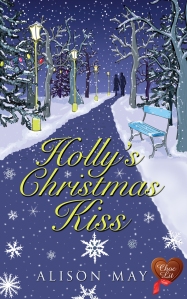
And finally… drumroll please… my second Christmas Kiss novella is nearly ready to be launched onto an unsuspecting world. Cora’s Christmas Kiss is going through its final tweaks and edits at the moment. We’re finalising the cover design, and it should be available to order very soon indeed. Squeeee! In the meantime I recommend that you all prepare yourselves fully by downloading book 1, Holly’s Christmas Kiss, forthwith.

Holly's Christmas Kiss

*takes a deep breath* So there you go. That’s all my publication news at the moment. And with that I shall stop thinking about books that are already written and turn my attention back to the books that are yet to come.

In which I randomly assert that writers are not special

I have two jobs. I have one job where I sit just exactly here on my rapidly expanding bottom and type words into documents that I hope one day people will want to read. In my other job I try to help people learn stuff. Sometimes I help them learn how to understand the welfare benefits system. Sometimes I help them learn how to write books. In the past I’ve helped people learn good interview skills, presentations skills, employment law, IT skills and various other things besides. It’s never crossed my mind that there might be some careers that you can’t learn to do. But some people think that my first job – the bottom sitting one – is just such a thing.

Back in March, Hanif Kureishi termed creative writing courses a ‘waste of time’. This caused a heightened level of eyebrow raising because Kureishi is a professor teaching in various areas of writing at Kingston University. It’s always good to see a tutor who’s confident in the quality of their own work, isn’t it? Having said that, other writers agreed with Kureishi about the limitations of creative writing courses, and he wasn’t the first to express reservations. Ray Bradbury, for example, told the Paris Review that college was a ‘very bad place for writers.

It seems to me that there are two things going on here. Firstly, there’s an unjustified leap in logic between identifying a bad course or poor teacher, and concluding that something can’t be taught. I’ve never been to one of Professor Kureishi’s lectures or tutorials, but if you find that a high percentage of your students are failing to learn the thing you’re supposed to be teaching, you’ve got to wonder if the problem is you rather than them. Many of Bradbury’s criticisms centre on the problem of tutors teaching based on their own preferences and likes/dislikes – that’s not a sign that’s something’s unteachable. That’s just a crappy teacher. There are lousy courses out there in plumbing, maths, crocheting, engineering and Japanese – it doesn’t mean that any of those things can’t be taught and learnt either.

And that brings me to the second thing I suspect is going on here. Us writers do sometimes have a slightly unattractive tendency to think that we’re special. Again, that’s not something that’s exclusive to writers – we all like to think that we are special unique snowflakes sometimes, but I think that sometimes as writers we tell ourselves that what we do is somehow different from other jobs. And in some ways it is – there’s a lot more pajama wearing than the average, for example. But we’re part of a whole raft of creative careers – from writing to fine art to theatre to engineering to graphic design etc. Any job that involves a moment where somebody says ‘What if we do…’ and the next thing that comes out of their mouth is an idea that wasn’t there before is creative. Creativity is brilliant, and precious, and, if you take a minute to look, absolutely bleeding everywhere.

I share my living quarters with EngineerBoy, and people often assume that we must have little or nothing in common in terms of how we work and how our brains work. But actually we talk about work all the time.* Designing engineering solutions and writing a book have a lot in common. Both start with an idea of what you’re trying to get to. Both suffer from the fact that that idea will, inevitably, change part way through the process. Both work best when you keep things simple. Both are marked by a bit about a third of the way in where you’re absolutely 100% certain that what you’re working on is a massive pile of poo that will never work. And then another bit like that about two thirds of the way through. And then another one just around the time you have to hit send and deliver the thing to your customer/publisher.

Writing a lesson plan is another act of creativity with lots in common with writing a story. A good lesson has a beginning, a middle and an end. It has a point that you hope the student will take away, and is has a great unknown quality that is beyond your control – for a lesson, that’s the student; for a story, it’s the reader. Both are going to take whatever you offer and respond to it, hopefully in the ways that you anticipated, sometimes in a completely different way, and sometimes, if you’re really lucky, in a way that makes the whole thing better, and richer and more successful than you ever thought.

Lots of jobs are like writing – some in small ways, some in much bigger ones, and generally we have very little problem with the notion that you can learn to do all those other jobs, but somehow we want writing to be innate. It’s not innate – at least not beyond the level at which human beings have a shared instinct to communicate and storytell. It’s something you can develop and improve. You can learn to be more creative, and you can learn to channel that creativity in specific ways. You can learn the skills of plotting and characterisation and editing and point of view.

And yes, part of the reason I’m saying this is because I’m a creative writing tutor and I have an upcoming workshop (spaces still available – click the link for details, go on, you know you want to) to promote. But it’s more than that. Telling people that certain skills can’t be taught is an example of people who’ve already achieved success adopting a mindset that keeps those who are still trying firmly in their place. It’s about saying ‘Well, I made it without any help. Why can’t you?’ And that’s just a bit of a miserable, divisive way of being. So bah humbug to that. Jolly good.

* Sounds dull, I know, but look. We’ve been married a really really long time. Any conversation beyond ‘What’s for tea?’ is frankly a marvel to be cherished at this stage.

In which I marvellously sort out the West Lothian question

So Scotland is staying. So far as I’m concerned this is excellent. I like Scotland. They have shortbread, a willingness to put batter around anything, and a refreshingly positive attitude to the notion of the wraparound skirt as menswear. All these things seem like markers of a jolly good place. So, yay Scotland! So glad you decided to stick around.

But politics moves quickly and with the ink barely dry on the final ‘no’ vote, the debate has already moved on to what we do next. Scotland has already been promised some form of ‘devo max’ with increased tax raising powers and greater autonomy over domestic policy, and David Cameron’s bleary-eyed statement first thing this morning promised to look at the issue of greater English autonomy over English domestic issues. This is the problem in UK politics usually referred to as the ‘West Lothian question‘  – in a nutshell, how does one resolve the problem of MPs from Scottish constituencies (like West Lothian) having votes in the UK Parliament on issues that only affect England (or England and Wales), when English MPs have no vote on the same issues in Scotland?

Essentially there are two possible ways to square this circle: either you continue to decide English domestic policy at Westminster and just don’t let Scottish MPs vote on those questions; or you establish a separate English Assembly or Parliament with equivalent powers to the Scottish Parliament.

The problem with the first of those is that you have a significant risk of ending up effectively two governments within the same parliament. The Conservative vote in the UK tends to be more concentrated in England, particularly southern England, whereas the Labour vote is stronger in Scotland, and also Wales. Obviously shares of the vote fluctuate but it’s fairly easy to imagine a situation where Labour hold an outright majority across the UK, but don’t have a majority of English MPs. In that scenario, who forms a government? Do we have a Labour government who are able to pass defence and foreign policy but are hamstrung on English domestic issues? Or do we end up with, for example, a Labour UK government, and a Conservative English government who time share the government benches and all swap places depending on what sort of issue is being debated?

The further problem with this solution is that by leaving English decision making at Westminster, you reinforce the idea that Scotland, Wales and Northern Ireland have their own exciting identities, and England is just a sort of Britain-lite. This annoys the other parts of the Union because it downplays their contribution to what Britishness is, and it, increasingly, annoys some of the English as well, as it denies them any sort of identity at all.

So, for me, a new English Assembly or Parliament feels like the way forward. It’s an idea I’ve never been keen on in the past. Honestly, on a cultural identity level, I feel human, and then British, and then European, and then Yorksire, and then possibly, if pushed, English. But I also think that treating all four nations within the union the same, in terms of what powers they hold directly and what is exercised from Westminster, is the only potentially equitable way forward. So if Scotland is to have increased tax raising and domestic policy powers, then I suggest that Welsh, Northern Irish, and English Parliaments should be treated in the same way.

To do that is really complicated. You need to work out an fair way of raising and allocating taxes to UK and individual nation spending. Doing that is a potential minefield, and involves the Treasury, in particular, loosening its grip on huge areas of policy and spending. Doing that super-fast, as David Cameron says he will, would be colossally stupid. Constitutional amendment has to be done right. If it’s not, you’ll be dealing with the fallout for not just years, but potentially decades or centuries. Constitutional changes have to be crafted and considered, and that’s doubly hard to do if you’re a country that doesn’t really have a clear single document written constitution to start with.

So what’s my vision for an English Parliament? Well first-off, it shouldn’t meet in London. London is the capital of the UK. It’s a major international city, and should be the place that all four nations can look to as their shared capital. An English Parliament should meet somewhere a bit more, well a bit more English. I’d suggest Winchester, or York, or Salisbury –  somewhere with a bit of Englishness in its history. I also feel that a properly English Parliament would stop around 4pm each day for tea, and members would show disapproval of another’s speech not by barracking and catcalling but by tutting pointedly.

So there you go Mr Cameron – the West Lothian question resolved before breakfast. Just, please, try to take a bit more time finessing the details.

In which I have read some books

I’ve always loved reading, but since I started writing fiction my reading has changed. There have been periods where I’ve found it really difficult to get into reading any sort of novel, but recently I’ve been on a bit of a reading binge. Hence, I have some book reviews to share. Because I like an arbitrary theme today’s reviews are all in the ‘commercial women’s fiction’ genre also known as ‘fiction.’ (You can catch up on me being ranty about genre names back here.)

1. Dear Thing – Julie Cohen

I know Julie Cohen via the RNA and Julie’s fabulous creative writing tutoring, but it’s unbiased reviews only here so I’m putting the fact that she’s lovely in real-life out of my mind and focusing on the stories. This is the first of two of her novels that are going to turn up in this post. That in itself has to be a good sign because it demonstrates that having read one book by the author I wanted to go straight on and read another. Dear Thing is a story about Claire and Ben, a couple who are desperate for a baby and have been through years of trying and fertility treatments. Ben’s best friend is Romily, who already has a child of her own and figures that carrying a child for her friends won’t be that big a deal.

Obviously the emotional realities of surrogacy turn out quite differently from what Romily imagined. In plot terms some of what goes on in Dear Thing is very much what you’d expect, but it’s grounded so deeply in the emotions of the characters that I don’t see that as a negative in this case. I particularly liked that this is a book that depicts fundamentally good-hearted people who, under emotional pressure, don’t always behave perfectly. I also very much liked the emotional conflict that Ben experienced – in some stories about parenthood the fathers are somewhat sidelined characters, so it was good to see both Ben and the father of Romily’s own child given a bit of depth.

My only reservation was that, perhaps, the very ending of the book resolved Romily’s story slightly too neatly, but that’s very much a personal preference thing; I always want stories to go darker and more complicated.

I don’t really do star ratings for books very comfortably – I always end up wanting to give scores like 4.82 stars, but I would definitely recommend this one.


2. Where Love Lies – Julie Cohen (again)

I did warn you that she was going to crop up again, so  no apologies for that. I won a copy of Julie’s latest book in an online comp from the author, and very lovely and shiny it was too. On paper the subject matter for this one intrigued me more than Dear Thing, being very much a non-baby person. Felicity is married to Quinn and living what many people would see as a perfect life, but something doesn’t feel right, and she finds herself drawn further and further away from Quinn and deeper into her past, and the more time she spends there, the more blissful it feels.

I’m not going to give away what’s actually going on with Felicity, but I was intrigued by her conflict throughout the story. Is it better to live in the here and now – problems, uncertainties and all – or would you take the option of living in a blissful dream? Where Love Lies is evocatively written and all the viewpoint characters are interesting in their own right. Part of me wishes that the author had held back what was actually happening to Felicity a bit more in the earlier sections of the story, as I did enjoy the uncertainty about what Felicity was feeling and why, but the bottom line is this – I absolutely rattled through reading this book, picking it up and whizzing through chapters when I was supposed to be doing other things, and making myself sleepy through my reluctance to put it down last thing at night, so that’s a big win.


3. The Sea SistersLucy Clarke

This was Lucy Clarke’s debut novel, and it’s the sort of debut that makes the rest of us feel deeply inadequate. It’s the story of Katie and Mia – two sisters whose relationship has been strained since the death of the mother. Mia is a free spirit, fearless and impulsive, whereas Katie is the responsible one, always taking care of her younger sibling. When Mia disappears, Katie is drawn into her sister’s world as she retraces Mia’s last journey to try to find out what happened to her little sister.

It’s high praise indeed for me to say that this book reminded my of Emily Barr. Emily Barr is one of my favourite writers, and has an incredible ability to evoke places and atmospheres. Clarke has the same gift and the contrast between Katie’s rather ordered normality, and the places she visits on her travels in search of the truth about her sister is tangible for the reader. The relationship between the sisters also feels real, and seeing both of the characters’ impressions of the other works well. As including one quibble seems to be customary – I would like to have seen Katie’s relationship with Finn fleshed out a little more, as I think this would have heightened the sense of conflict in that part of the story. That’s a minor point though. The key relationship in this story is the one between the sisters, and that sings out loud and true from the pages. Another page-turner. Highly recommended.


So three books I really liked. You could go read them if you wanted. You could also offer me some recommendations down in the comments…

In which I wonder if we get too hung up on the f-word

I’m a feminist. I’ve described myself as such since I was about 14 and I’m not about to change now.

I think that girls across the world should have just as much right to go to school as boys. I think that women and men should be paid the same for comparable work. I think that on the three separate occasions during job interviews when I’ve been asked whether I felt I’d be taken seriously in the role I shouldn’t have just sucked it up and got on with the interview; I should have queried why the interviewers thought that might be an issue. I think that expecting the man to automatically pay on a first date is dumb. I think that a man holding a door open for a woman is fine, but I think a woman holding a door open for a man is fine too – generally letting doors slam in people’s faces is bad; that’s not actually a gender issue. I think that conviction rates for sexual violence against women are shockingly low. I think that the tendency in the media to describe women by their age and appearance first, and job or role second is depressing and damaging. For all those reasons I’m a feminist, but.

But, I also think that we need to accept that the term ‘feminist’ has become a bit tricksy of late. Various celebs have declared themselves ‘not a feminist’ and there was recently a spate of ‘I don’t need feminism’ selfies, where women held up signs explaining their reasons for rejecting feminism. This was followed, inevitably by a much bigger spate of ‘I need feminism’ selfies, which I absolutely support, but I worry that by simply responding with a chorus of ‘Oh yes, you do,’ we’re missing a point. If you do an images search for ‘I’m don’t need feminism because’ you’ll see that there are two repeated themes in the rejections of feminism. The first is that feminism is about supremacy over men, and the second is that feminism encourages a victim-mentality by defining a range of inconveniences as gender oppression.

The first of those perceptions is, in many ways, the easiest to reject. Feminism isn’t about saying that women are better than men. It is about rejecting the automatic reverse assumption. It is about rejecting the notion that an area of life/work has less value because it has historically been primarily undertaken by women. It is about rejecting the notion that gender should be a primary decider of your path in your life or career. And that works for men and women. Hurrah for the male nursery nurses, and dental nurses, and just plain nursing nurses.

The second problem is the perception that feminists see oppression everywhere and revel in the role of victim. Well, here’s the thing. Some people revel in the role of victim. Some of those people will be women. Some of those women will be feminists. Don’t confuse personality trait with wider philosophical message. Nonetheless, the perception that we are the girls who cry wolf, is damaging to the cause of equality. It legitimatizes the patting of women on their collective head, and the shuffling away of grievances onto the pile marked ‘women making a fuss.’

The saddest thing is that all those young women holding cards saying, ‘I don’t need feminism because… I’m not a victim’ or variations on that theme are making a feminist statement. They’re saying I’m not defined by oppression. They’re saying that they believe in their own ability to take life’s opportunities and make the most of them. But they’re rejecting the political and social force that got them to a place where posting a picture of themselves in a public forum making a political statement is permissible behaviour for a young lady.

Ultimately, ‘feminist’ is just a word, and maybe it’s a word that both sides of this argument need to be less hung up on. If you believe in equality of treatment, choice and opportunity for men and women, then what label you put on that should be secondary. Feminism has become a troublesome word because, at some point, the people who say ‘I am a feminist’, and the people who say they’re not, started using the same word to mean different things. If feminist meant man-hater, or eternal victim then I’d be lining up with the girls holding those ‘I don’t need feminism..’ cards myself, but to me it means something quite different. And that’s the problem. If we don’t agree about what it is that we’re embracing or rejecting how can we identify our disagreement and our common ground?

So a question for the comments section: Would you describe yourself as a feminist? And why or why not?

In which I am a terribly ungrateful poorly girl

Day 5 of my 5 blogs in 5 days (aka Alison’s Awesome Week of Daily Blogging). So far we’ve been on holiday, we’ve been annoyed by open letters, and we’ve moaned about lack of diversity in government, and today I’m going to talk about me, because that is pretty much my favourite subject, and I am – at least in this corner of the interweb – a special and important little snowflake.

I suffer from IBS. For the uninitiated, IBS stands for Irritable Bowel Syndrome. That fact should do two things: firstly it should tip you off that this blogpost might involved reference to bottom business; and secondly it should give you a mental image of a bowel with a face, reading the Daily Express and chuntering to himself. Yes – for reasons I can’t really explain my mental personification of my bowel is male. Male with quite a fulsome moustache, since you ask.

Anyhoo, IBS is one of those modern illnesses that some people don’t really think exists, and is what doctors refer to as a functional disorder. That basically means that your bowel doesn’t quite work in a tiptop way, but the reasons for that are as yet not fully identified. Diagnosis is done by a process of ruling out all the stuff that doctors already know makes bowels abandon normal function (coeliac disease, cancer, crohns disease etc.) This is generally achieved by the method of sticking a tiny camera into places that no camera ever had ambitions to go and having a jolly good footle about to look for badness. If no specific badness is identified, then congratulations – you have IBS.

In practical terms that means that I suffer from stomach aches a lot, often with added constipation and diarrhea (sometimes, weirdly, on the same day). Diarrhea, for me at least, usually passes pretty quickly (well, obviously) on its own. The stomach aches can be fairly well treated with a wonderful little IBS drug called Buscopan, but the constipation is a right pain in the… *Handbrake turns the blog away from a very obvious, and somewhat yucky, joke.*

So those are the symptoms but that’s not what this post is about. It’s not, despite everything that’s gone so far, about my irritable bowel. It’s about irritable me. And I get irritable with people. Specifically people who are neither my GP, nor my consultant gastroenterologist, who want to offer me medical advice on this problem.

‘It’s probably stress,’ they say.

‘I’m not stressed,’ I say.

‘You are. Stress is what causes it. I had a stomach ache in 1982. That was stress.’

‘I’m not stressed.’

They tip their heads and adopt a sympathetic tone. ‘You’re putting on a brave face. That means you’re not dealing with your stress.’

‘I’m not stressed,’ I screech.

‘Well you sound stressed,’ they say

I’ve had versions of that conversation in real-life and on the modern social media a number of times since I was diagnosed, and I’m kind of vaguely aware that my irritability reflects worse on me than on the poor innocent sympathetic passerby, but I do get irritated. I occupy a weird double space where I want to be treated absolutely normally and not have to deal with any sort of sympathy or helpful suggestion about the herbal remedy that really helped your Aunt Tallulah, but I also want people to appreciate that sometimes I feel ouchy and this can lead to grumpiness. And I do get that that’s probably not really possible. Ah well, into each life some rain must fall etc. etc. Other people have far worse things to deal with. Every cloud has a silver whatnot. And other similar platitudes.

So that’s it for my 5 posts in 5 days week. It’s been slightly random but I never promised coherence, so there you go. I’m going to try to get back to regular weekly blogging from now on. Probably on Mondays or Tuesdays but we’ll see how it goes. In the meantime, you can always buy a book

In which I do a little bit of a politics catch up

During my period of non-blogging, on account of all the book-finishing and holibob-going, a range of politics has occurred. Three things in particular caught my wandering attention: firstly, David Cameron had a little cabinet reshuffle; secondly Sayeeda Warsi resigned from the government; and thirdly Mark Simmonds resigned from the foreign office.

The cabinet reshuffle was generally seen as a pre-election attempt to move aside some of the less popular figures in the government, notably Michael Gove, and to bring in some new blood, specifically lady blood, on account of how David Cameron is totally down with equality, at least now it’s been explained to him that holders of a uterus are also allowed to vote. What the reshuffle was trying to say was that the cabinet are modern; they’re in touch with the normal people; they’re just like us. What would be quite poor, from a PR perspective, then would be to lose one of your most prominent female, and most prominent non-white, minister shortly after the reshuffle.

Baroness Warsi resigned in protest at the government’s failure to come out with a strong response to Israel’s military action in Gaza. Since quitting she’s been pretty vocal about the difficulties she feels she experienced within cabinet in terms that only serve to exacerbate the image of a group of privileged, out of touch, old public school boys unable to engage with the wider world.  But that’s just one person’s opinion. So long as it’s not followed up by another minister complaining publicly about how terribly hard done by he is by being paid shedloads, I imagine David Cameron will probably still feel that things are going ok.

Oh dear.

On August 11th, Foreign Office Minister, Mark Simmonds, resigned citing the impossibility of housing his family in central London on his meagre expenses allowance as his reason for stepping down. Now I actually feel that it’s really important that MPs are reasonably paid and remunerated for their costs. If they’re not, then politics really does become an avenue only open to people who are already wealthy. However, this is Mark Simmonds, who was employing his own wife as his office manager on a salary of £20k+ on top of his own £89k salary, and refused to consider the horror of renting a property in outer London. This is an expenses system that allows for 30 return trips per year from constituency to London for MPs’ family members, and would have allowed Mr Simmonds around £28,000 per year towards rent on a London property. The reality is that however ‘intolerable’ Mr Simmonds found his situation, most people, in a country where food banks and rough sleeping are things that happen, will struggle to sympathise with someone bemoaning the meanness of only being allowed slightly more than the national average salary to pay for his second home.

So, if you’re a Prime Minister trying to look open to diversity, modern, in touch with the country at large, I would have to conclude that it’s not been a great couple of weeks. Having said that, part of me is slightly cross with myself for writing this post. If I’m going blog about politics it probably should be about stuff that matters: like education; or the NHS; or the feeble international response to the situation in Gaza.

But actually I think the other stuff – the stuff about perceived privilege and lack of equality – is more than just PR and Westminster bubble vacuousness. We are supposed to be a representative democracy, but the people who are supposed to represent us don’t reflect the range of people in the country, and I think that does matter. Diversity is one of those concepts that people pay lip service to. ‘Yes, it would be great to have more women, but they don’t apply.’ ‘Obviously we’d be open to more disabled candidates, but there are practicalities to think about.’ ‘Of course we want more black people, but they just happen not to have made it through the selection process this time.’ More diversity in government gives you a broader range of experiences to pool into policy making. That gives you a broader range of ideas, and a broader range of expertise. That gives you a much better chance of coming up with a good idea, and of spotting the flaws in the terrible ones. It makes decision making less cosy, but ultimately better, and that should be what matters – that our politicians make the best decisions and pursue the best possible policies for the whole country and for the gloriously diverse mixture of people who live in it.

So that was day 4 of the Week of Awesome Blogging. Come back tomorrow for some more, when I shall be writing about something. I have no idea what. Jolly good.

In which I weigh into the whole Amazon vs Hachette ebook pricing argument

Day three of the Awesome Week of Daily Blogging and the posts are still coming thick and fast.* Today I thought I’d weigh into the whole Amazon vs Hachette debacle, because for a new author currently exclusively ebook published on Amazon there’s no way that could be unwise. (‘You have books on Amazon?’ I hear you ask. ‘Why Alison, you hardly mention that at all!’ Indeed. I am too modest. They’re here. Feel free to go buy them.)

For those of you who don’t spend your free time reading articles about corporate disputes in the publishing industry, essentially Amazon (who I’m guessing you’ve heard of) and Hachette (who are a big publisher) have fallen out over new contract negotiations over ebook pricing. Amazon think ebooks should be cheaper. Hachette don’t agree, or, perhaps, just don’t want that to be up to Amazon. I’m simplifying, obviously, and if you’re really interested in the finer details you know where google is, and, if that’s too much effort, there’s some interesting stuff about the changes in the ebook pricing model that led up to this point here.

What I am going to bang on about is the way in which this whole hullabaloo** has led to an outbreak of rather bizarre open letter writing. 900 authors have signed this letter ‘to their readers,’ but actually clearly aimed at Amazon, and helpfully popped the whole thing in the New York Times. Amazon have written this letter to their kindle authors, but actually clearly aimed at Hachette, and, even more helpfully, popped it on the interweb for the world to see too (horribly misrepresented Orwell quote and all). Now part of me applauds this approach to doing business. It might have been thought that letter writing was a dying art, but apparently not. What does seem to be a dying art is the ability to address one’s letter to the relevant person and pop it in an envelope. Open letters are suddenly very much in vogue.

It’s not limited to publishing industry pricing disputes. Gyrate around on TV wearing a flesh coloured leotard accessorized with 2013’s Robin Thicke and people start writing them. Suggest that people ought not to vote, and people write them. And frankly I’m a bit annoyed. Irrationally annoyed, I admit, but annoyed nonetheless. If you want to say something to one individual or company, write them a letter. If you want to say something to a more general audience, write an article or a book or a blogpost or an exceptionally pithy tweet. If the thing you want to say is primarily aimed at improving your own commercial position then be honest with the universe and write an advert.

I’m not quite sure what it is about open letters that winds me up so. Actually, yes, I am sure. It’s the double standard. Open letter writers are trying to have it both ways. When you write something publicly you run the risk that people will think it’s dull, or crap, or will just disagree vehemently with the thought you’ve spent hours crafting and trying to communicate. When you call the thing you’ve written an open letter, you’re giving yourself a get out of being able to pretend it was only really aimed at the named recipient. But it’s not, is it? Because if it was you’d have got a stamp and an envelope and just sent it to them. But maybe you can’t. Maybe the person in question hasn’t given you their address, or email, but that couldn’t possibly be because you don’t know them and they don’t care what you think, could it? Obviously they, and everyone else, need to know what you think. Which is fine. I’m in no position to criticise anyone for the random spouting of opinion at the world. But stop pretending that it’s personal, when it’s just some stuff you reckon.

Now that’s probably a tad unfair on the authors who wrote to their readers, and the wider world, about Amazon. They do clearly have a vested interest in the dispute between Amazon and Hachette and in the wider direction of travel of ebook pricing and the bigger question of who now controls the publishing industry. But there’s another element that I find difficult here, which is that it’s starting to feel as though authors are expected to pick a side. I’ve been asked on facebook and other forums for a view and it’s tricky. The bottom line is that Amazon are a big ol’ business. They’ve already killed off a huge section of the physical bookselling market. They’re moving aggressively into publishing. From a commercial point of view, I see no reason why they wouldn’t want to dominate on both the publishing and retail sides of the business, which sounds bad, but they’ve also brought opportunities for new authors (me included) through the ebook market and the explosion in self-publishing which Amazon has massively supported. Big publishers are increasingly risk averse – previously secure mid-list authors have seen their contracts cancelled or not renewed in recent years, pushing many of them, slightly ironically, into Amazon’s self-publishing embrace.

For the individual players in the system – readers and authors – any one company, or cohort of companies, having dominance is probably not ideal, but being asked whether you’d prefer your industry to be dominated by one retailer or by a few big publishers is no real choice at all. What I want, as an individual author, is to get good quality books out to readers, and to be able to make a living from doing that. However the current round of chips falls, it feels like it’s getting harder and harder to do that.

And everyone breathe. Thank-you.

* Once per day. At best.

** It’s definitely the correct technical term. Stick with me.

In which I tell you what I did on my holidays (part 2)

Yesterday I kicked off The Awesome Week of Daily Blogging (as I’m now totally terming it) with part 1 of my exciting adventures on holiday. So by the laws of numbers and counting and that, welcome to part 2 in which I will do some actual recommending and reviewing of a tiny percentage of the tiny percentage of Edinburgh Fringe shows I managed to see last week. In order to do this I shall split all 19 shows that I saw into entirely arbitrary (and probably poorly conceived) categories and declare a winner in each section. The Some Random Woman’s Blog Awards – trust me; all the acts at the fringe will be talking about them. Probably.

Category 1: Sketch Comedy

Contenders: Cambridge Footlights, The Reduced Shakespeare Company

Only two contenders in this section, and one of them isn’t really sketch comedy because it had a sort of over arching narrative, but these aren’t the sort of details that I’m going to let hold me back. It’s a tough one to call. I love the Reduced Shakespeare Company – their Complete Works of Shakespeare (Abridged) is a thing of comic wonder, but this show, The Complete History of Comedy, lacked the same level of tightness and precision, despite a few very funny moments.

Cambridge Footlights I felt a bit sorry for – at least as sorry as you can feel for high-achieving, talented people who are half your age. The knowledge that you’re part of the group where Stephen Fry, Hugh Laurie, Emma Thompson, Robert Webb, David Mitchell, Richard Ayeode etc. etc. started out must carry with it a certain amount of pressure. And to be honest, their fringe show, ‘Real Feelings,’ did follow Mitchell and Webb’s edict about sketch shows being hit and miss, but the hits were proper, big, guffaw-out-loud hits, so for that reason my first category winner is….. Cambridge Footlights.


Category 2: Stand-up Comedy but with some sort of additional element eg. characters, songs or a talking monkey

Contenders: Mitch Benn, Pippa Evans, Nina Conti, Cal Wilson

Now I did admit that the categories were likely to be poorly conceived. And indeed they are. I’m not at all convinced that these four acts are really comparable, but I’ve come this far, so I’m ploughing on.

The second problem with this category is that I basically loved them all. This is great from an audience-member perspective, but really bad from the point of view of writing insightful reviews, and even worse if you’re trying to pick a favourite.

Mitch Benn’s show is all about skepticism with songs. Pippa Evans talks (and sings) about trying to work out who she is. Cal Wilson explores a similar theme with character comedy based around how she might have turned out if she’d made different choices in life. And Nina Conti has a talking monkey. But her show is so much more than a woman with a talking monkey. She does a terrifying amount of audience participation – if you’re the sort who gets nervous when a comedian starts chatting to the people in the front row, then wait for the DVD. And it’s all hysterical, and it messes with your head. You know she’s a ventriloquist, so you know that all the words are hers, but you reach a point where you genuinely believe she’s surprised by what’s apparently being said to her. And it’s hysterically funny. I mentioned that already, didn’t I? Anyway, out of four fantastic shows, the winner, for pure nearly-wetting-self can’t stop laughingness is…. Nina Conti.


Category 3: Improvisation

Contenders: What does the title matter anyway?, Set List

What does the title matter anyway? is the Edinburgh Fringe show not in anyway based on the popular TV show ‘Whose line is it anyway?’ whilst being hosted by the same person, featuring the same cast and involving the same games. Apart from that it is absolutely definitely completely different in every way. And very funny it was too. Josie Lawrence stole the show with her ability to improvise songs at the drop of a hat, but the whole thing was really jolly good. Just like I remember it from the telly, had it been on the telly, which, for legal reasons, I’ll just reiterate, it definitely wasn’t.

Set List is ‘comedy without a safety net.’ Comedians turn up with no prepared material and have to improvise a set based on phrases, words and acronyms that pop up on a screen at the side of the stage. It was a fascinating show from a writer’s perspective as you got to see the creative process happen (or not) right in front of you. The were six comedians performing on the night we went and, as you’d probably expect, it was a mixed bag. Those who nailed it, notably Cal Wilson, properly nailed it, but overall the quality was patchy, and for that reason the winner is… What does the title matter anyway?


Category 4: Other Stuff

Contenders: And the Goat Remained a Goat, Tanya Byron, I Killed Rasputin

OK, so I accept the categorisation has really broken down. Now I’m comparing a cabaret show about a early twentieth century ghosthunter, a talk about young people and mental health from an eminent clinical psychologist, and a stage play about a Russian assassination. All righty then.

‘I Killed Rasputin’ is a play by Richard Herring about Felix Yusopov, one of the conspirators involved in Rasputin’s murder. It’s an interesting subject and an interesting, and surprisingly funny, play, with some excellent performances, but for me it was just a little bit too uneven in terms of the tone. In places I felt like Herring needed to trust his audience more. There was a slight tendency to overtell. The play ran to 1 hr 20 minutes, rather than the usual 1 hr fringe slot. Editing it down to an hour and reining in the overtelling would have been an improvement I suspect.

So that leaves two contenders – Tanya Byron’s interesting, knowledgeable, and refreshingly opinionated talk vs. a deeply weird music/magic show about a ghost hunter from Richard Wiseman and The Creative Martyrs. Professor Byron was fascinating but this is the fringe and I think it’s important that we recognise the importance of weirdness to the whole proceeding. So for weirdness, and for my single favourite funny line of the whole fringe (which I’m not telling you, because out of context it makes zero sense), and for including a talking mongoose, the winner is…  And the Goat Remained a Goat.


Category 5: Stand-up Comedy

Contenders: Bob Graham, Danny Bhoy, Lucy Porter, Shappi Khorsandi, Sara Pascoe, Susan Calman, Tom Stade, Andrew Maxwell

A big old category to finish with, and a really hard one to call. I think six of the eight comedians in the list are definitely in the running, so let’s be cruel and deal with the other two first. Bob Graham had some nice material in his set, but nothing that really set the room alight. Sorry Bob – you were perfectly decent but you’ve found yourself in a tough group. Tom Stade is also out of the running. Ultimately comedy is subjective. There were people at his show laughing their little hearts out, but it didn’t do anything for me, and this is my little corner of the internet where my word is law, so he’s out too.

Which leaves us with six, which is still way way too many, but they were all excellent. Seriously, if you’re in Edinburgh over the next couple of weeks and you get the chance, seeing any of those six is well worth the cost of a ticket. They’re all very very funny, and all have jokes or sections from their set that I keep replaying in my head and giggling to myself over. I’ve changed my mind about 48 times over who’s going to win this category, and it’s definitely down to Danny Bhoy or Shappi Khorsandi. Or Susan Calman. Or maybe Andrew Maxwell. Aaargh. It’s too hard. I’m just going to keep typing and hope my fingers pick one. And the winner is… Shappi Khorsandi. Probably. Definitely. But with honourable mentions to Danny Bhoy and Susan Calman. It was really really close.


So there you go. Overall I think I did ok. Nineteen shows, and only one that left me cold is a pretty decent hit rate, but these are my final Edinburgh Fringe recomendations. If you’re in Edinburgh and you want to see a slightly random, but very entertaining, cross section of stuff you should check out: The Cambridge Footlights, Nina Conti, And the Goat Remained a Goat, What does the title matter anwyay? and Shappi Khorsandi or Susan Calman, or Danny Bhoy, or maybe Sara Pascoe. Waaah. I’m just going to stop now. Bye bye.


In which I tell you what I did on my holidays (part 1)

Hello world. I’ve just got back from holidays, which is my excuse for the, otherwise inexcusable, lack of recent blogular action. This week that will be very much rectified with an unprecendented five blogposts in five days. Let the bugles be sounded and the batons be twirled in excitement, at least until about Wednesday when I will presumably become distracted from the whole endeavour.

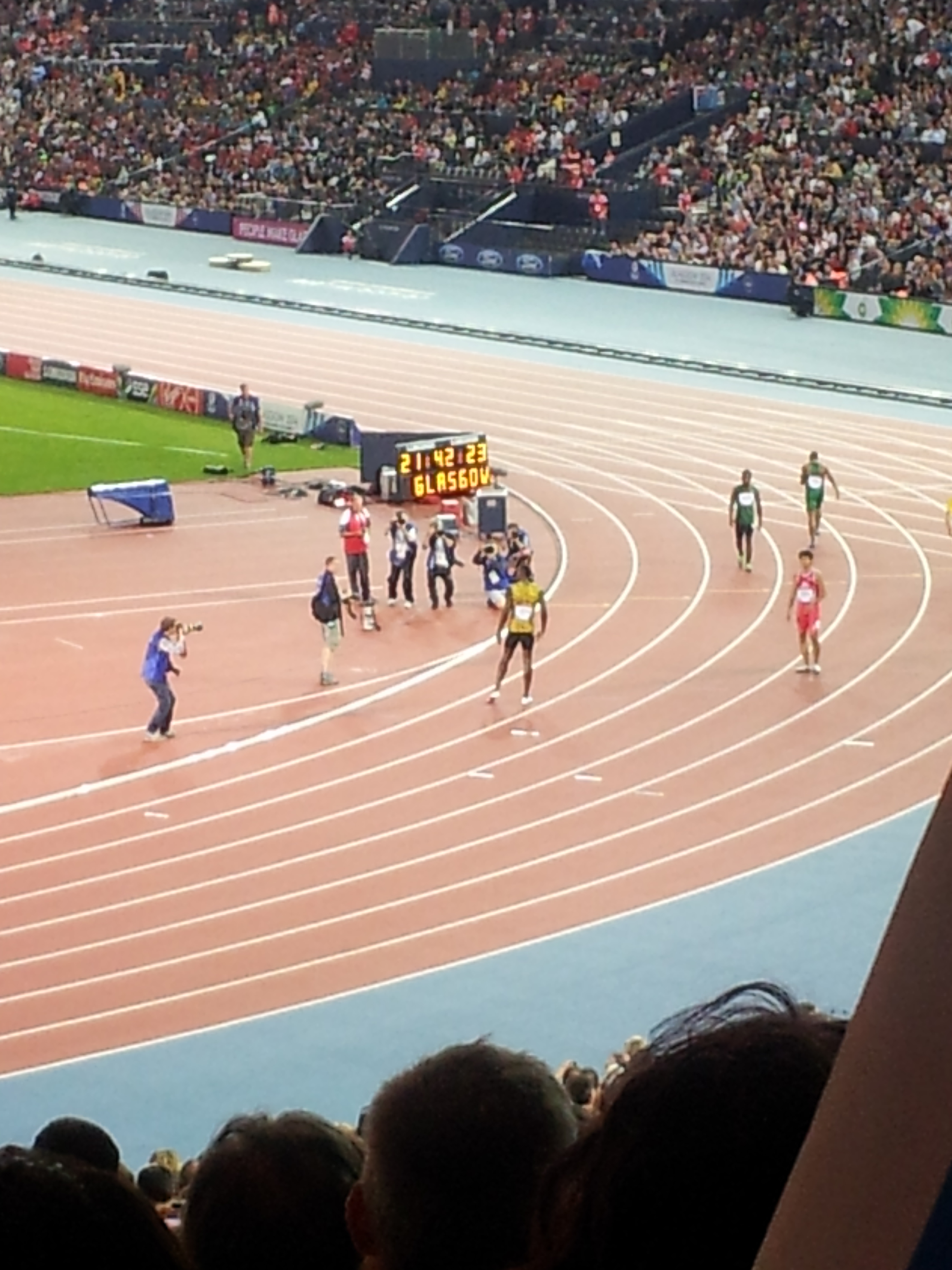
Anyhow, let’s start as we mean to go on with not one, but two, posts about what I did on my holidays. First off I went to the Commonwealth Games where there was athletics and badminton and hockey and gymnastics and rugby sevens. Here’s an actual picture of actual Usain Bolt to prove I was there.

Usain Bolt (in the middle there, honest.)

Anyway, I’m not going to bang on too much about the Commonwealth Games. I like a bit of sport, and this was a very jolly bit of sport, but I’m guessing that those of you who are right-thinking enough to be interested will have watched it on telly for yourselves. Seeing the sport live is much the same but with a slightly poorer view and no red button for switching to iPlayer part way through.

What I am going to bang on about, however, is the Edinburgh Fringe which occupied week two of the holibobs period. I’ve never been to Edinburgh during festival season before and can only concede that that was a colossal error of judgement on my part. The fringe is awesome, and massive, and overwhelming, and weird. Really really weird in places.

Not a weird bit of fringe. An entirely normal bit of zoo.

EngineerBoy and I took a day off midweek to go to the zoo and watch Bake-Off, but still managed to fit nineteen shows into the remaining five days in Edinburgh. We probably could have done more, but not without being reduced to jibbering, entertainment-overwhelmed shells of human beings. We tried to work out how many shows were on at the fringe in total and gave up. There are over 400 fringe venues, many of which house multiple performance rooms, which each host shows throughout the day from morning until well after any sane person is all tucked up in sleepy land. We didn’t even scratch the top layer of the outermost bit of surface.

What we did manage to see was *deep breath*: Bob Graham, Danny Bhoy, Lucy Porter, Mitch Benn. Richard Wiseman & the Creative Martyrs in ‘And the Goat Remained a Goat,’ Shappi Khorsandi, the Cambridge Footlights, Nina Conti, Sara Pascoe, the Reduced Shakespeare Company’s Complete History of Comedy, Susan Calman, What Does the Title Matter Anyway? (a show that bore no resemblance at all the TV show ‘Whose Line is it Anyway?’), Set List, Tanya Byron, Nicola McAuliffe in ‘I Killed Rasputin,’ Cal Wilson, Tom Stade, and Andrew Maxwell. And most of them were brilliant. Only one was awful. If you come back tomorrow I shall be splitting all of them into entirely arbitrary categories, one of which will almost certainly be called ‘Other Stuff,’ and recommending my favourites.

In the meantime, as ever, if you want to read more by me, I have books. You can do buying of them here.